
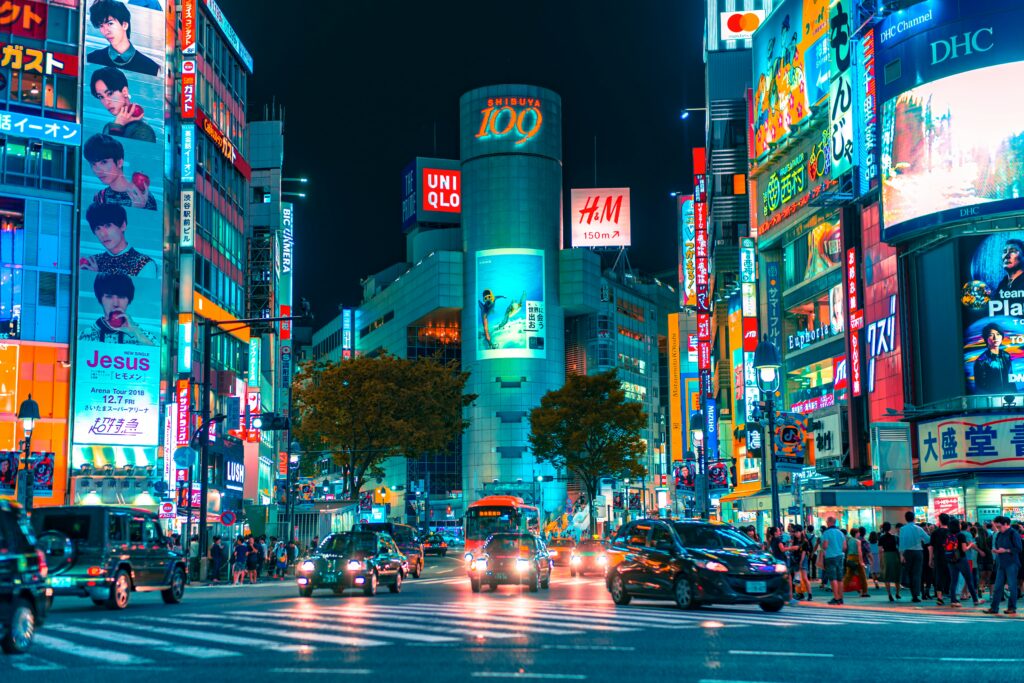
Japan Travel Tips First Time Visitors Need: The Complete Guide
Japan is unlike anywhere else on earth. The streets are immaculate. The trains run to the second. A bowl of ramen served in a basement restaurant can genuinely be one of the greatest meals of your life. These japan travel tips first time visitors need are mostly about mindset rather than logistics. Japan is extraordinarily easy to navigate, remarkably safe, and deeply welcoming to foreign travelers. The learning curve is real, but it is shallow. Most people feel at home within 48 hours.
This guide covers everything you need to know before your first trip: from the best cities to visit to how to get around, what to eat, how to behave, and when to go.
Why Japan Should Be on Every First-Time Traveler’s List
Japan offers a travel experience that is genuinely unlike any other destination. Ancient temples sit beside glass skyscrapers. Centuries-old tea ceremony traditions coexist with some of the world’s most advanced technology. The countryside is quietly extraordinary: bamboo forests, volcanic lakes, terraced rice fields, and onsens carved into mountainsides.
Additionally, Japan is one of the safest countries in the world for travelers. You can leave your bag on a table in a Tokyo cafe and return twenty minutes later to find it exactly as you left it. That ease of travel removes enormous mental friction and lets you focus entirely on experiencing the country.
For first-time visitors, the contrast between what you expect and what you find is part of the magic. Japan rewards curiosity and patience with experiences that stay with you for decades.
Best Cities to Visit in Japan for First-Timers
Japan has dozens of remarkable cities, but first-time visitors typically build their itinerary around three or four core destinations. Each one offers a fundamentally different experience.
Tokyo
Tokyo is the obvious starting point. It is the largest city in the world by some measures, and yet it manages to feel human-scaled and navigable. The neighborhoods are wildly distinct from each other: quiet temple districts in Asakusa, the electronics labyrinth of Akihabara, the luxury boutiques of Ginza, the chaotic energy of Shinjuku at midnight.
Most first-time visitors spend three to four days in Tokyo and still feel they have barely scratched the surface. Build in time to get genuinely lost. Some of the best experiences in Tokyo are stumbled upon rather than planned.
Kyoto
Kyoto is Japan’s cultural heart. The city was the imperial capital for over a thousand years, and the weight of that history is visible on every street. The Fushimi Inari shrine with its thousands of torii gates, the bamboo grove at Arashiyama, the wooden machiya townhouses of Gion: these are images most people associate with Japan before they have ever visited.
Two to three days is a reasonable minimum for Kyoto. However, travelers who stay five or six days often describe it as the best decision of their trip. The city reveals itself slowly and rewards the patient visitor.
Osaka
Osaka has a personality distinctly different from Tokyo and Kyoto. It is louder, funnier, and proudly food-obsessed. The locals have a saying: kuidaore: eat until you drop. Dotonbori, the city’s neon-lit entertainment district, is one of the most visually spectacular places in Japan after dark.
Osaka also makes an excellent base for day trips to Nara (where deer roam freely around ancient temples) and Hiroshima (a deeply moving and historically essential visit).
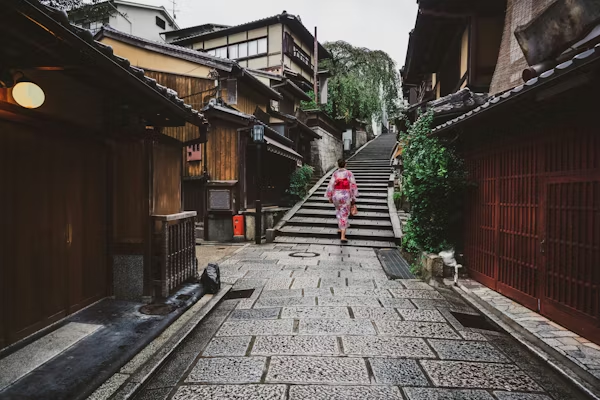
Kyoto’s temple districts look exactly like you imagined: and are even more extraordinary in person.
How to Get Around Japan
Japan’s public transport system is genuinely world-class. For first-time visitors, understanding the basics before arrival removes most of the stress from getting around.
The Japan Rail Pass
The Japan Rail Pass (JR Pass) is a prepaid pass that gives unlimited access to most JR trains across the country, including the famous Shinkansen bullet trains. It is sold exclusively to foreign tourists and must be purchased before arriving in Japan.
Whether it saves you money depends on your itinerary. If you are traveling between Tokyo, Kyoto, and Osaka, a 7-day pass typically pays for itself. According to Japan’s official tourism website, the pass also covers many local JR lines within cities, which adds significant value for multi-city trips.
IC Cards
For getting around within cities, an IC card (Suica or Pasmo) is essential. These reloadable transit cards work on almost every subway, bus, and local train in Japan. They also function as payment at convenience stores, vending machines, and many restaurants. Load one at any major station upon arrival: it will be one of the most useful things you do on day one.
Taxis and Ride Apps
Taxis in Japan are clean, reliable, and expensive. They are worth using for short trips when carrying heavy luggage, but for general travel, the train network is faster and far cheaper. GO is the most widely used ride-hailing app in Japan and works well in major cities.
Japan Travel Tips: Money and Payments
Japan remains significantly cash-dependent compared to most developed countries. While payment options are expanding rapidly, many traditional restaurants, temples, and smaller shops still operate cash-only.
- Carry cash at all times: 10,000 to 20,000 yen per day is a reasonable budget for mid-range travel
- 7-Eleven, FamilyMart, and Lawson ATMs reliably accept foreign cards
- Never tip: tipping is considered rude in Japan and will cause genuine confusion
- Convenience stores (konbini) are remarkably good for meals, snacks, and essential supplies
- IC cards work for small purchases throughout most cities
Japanese Culture: What First-Time Visitors Need to Know
Japan has a rich set of social customs that are worth understanding before you arrive. None of them are difficult to follow, and making the effort: even imperfectly: is genuinely appreciated by locals.
Shoes and Indoor Spaces
Always remove your shoes when entering a home, many traditional restaurants, and some temples. A genkan (entrance area) lower than the main floor is the signal. Wear socks that you are comfortable with others seeing.
Eating and Drinking in Public
Eating while walking is generally considered impolite in Japan. Most people eat at designated spots or standing at a stall. Drinking from a can or bottle while walking is more accepted, but eating a full meal while strolling through a shopping district will attract quiet disapproval.
Queuing
The Japanese queue for everything, and they do it with extraordinary patience and precision. Join the line, stay in it, and resist any temptation to edge forward. On escalators, stand on the left (or right in Osaka: the one consistent regional exception) and leave the other side free for people who wish to walk.
Onsen Etiquette
Visiting an onsen (hot spring bath) is one of Japan’s great pleasures. The rules are simple: wash thoroughly before entering the communal pool, do not bring towels into the water, and tattoos are prohibited at most traditional onsens. Some newer facilities have become more accommodating, but it is worth checking in advance.
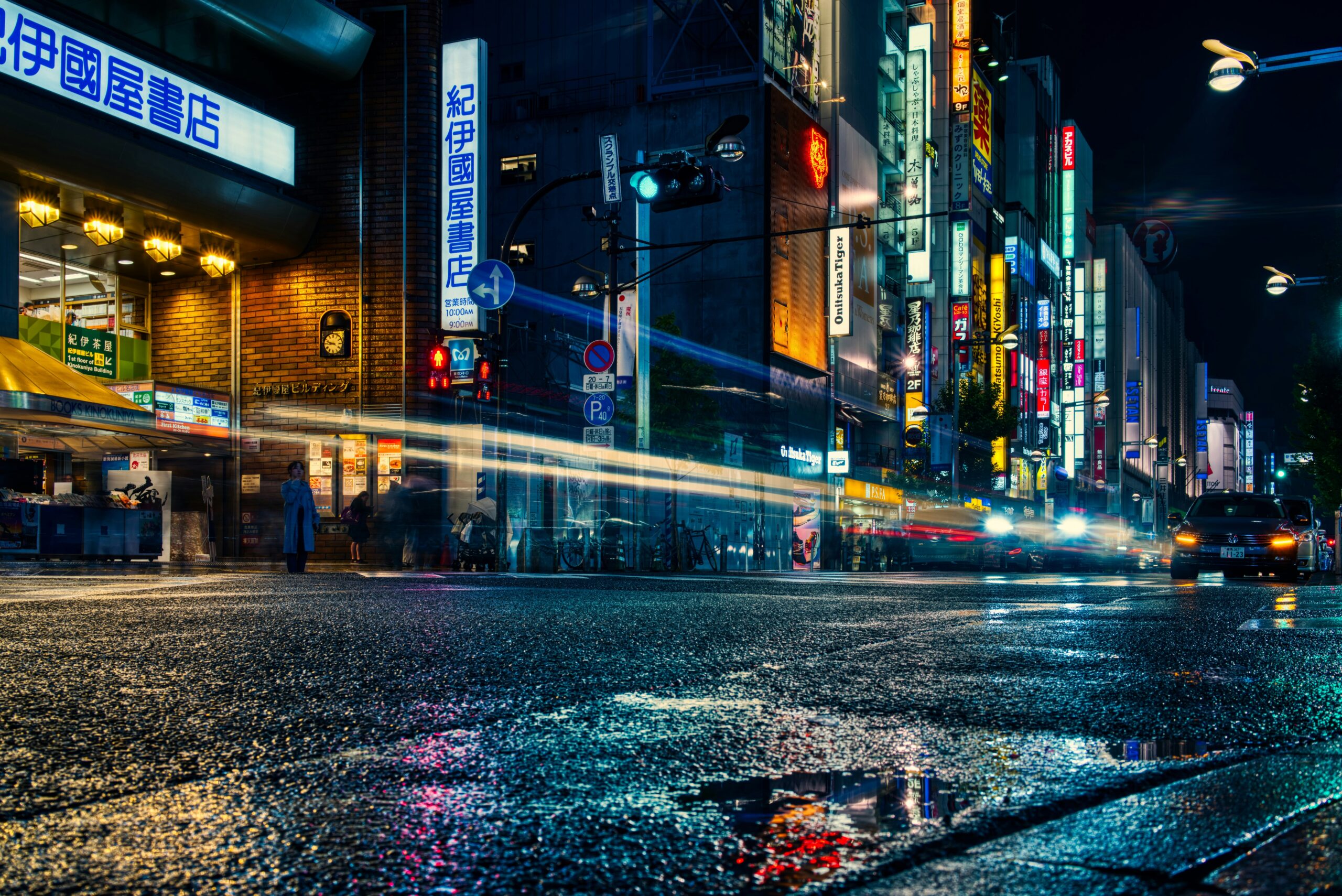
Tokyo after dark is one of the world’s great urban spectacles. Shinjuku and Shibuya are the obvious starting points.
What to Eat in Japan
Japanese food culture is extraordinary in its depth and variety. First-time visitors are sometimes surprised to discover that what they thought of as Japanese food: the version served in Western restaurants: bears only a passing resemblance to what people actually eat in Japan.
Essential Foods to Try
- Ramen: regional varieties differ dramatically. Sapporo’s miso ramen, Tokyo’s shoyu ramen, and Fukuoka’s tonkotsu are each worth seeking out specifically
- Sushi and sashimi: at a tsukiji-style market or a counter restaurant where the chef selects what is freshest that day
- Izakaya food: Japanese pub dining, with small plates of yakitori, edamame, karaage chicken, and cold Sapporo beer
- Convenience store food: this sounds absurd but is genuinely excellent. Onigiri, hot croquettes, and seasonal items from 7-Eleven are a legitimate travel experience
- Wagyu beef: if the budget allows, a wagyu meal in Kobe or Tokyo is a once-in-a-trip experience
Best Time to Visit Japan for First-Timers
Japan has four distinct seasons, and each one offers a genuinely different experience. For first-time visitors, spring and autumn are the most celebrated and, consequently, the most crowded.
| Season | Months | Highlight | Crowds |
|---|---|---|---|
| Spring | March–May | Cherry blossoms (sakura) | Very high |
| Summer | June–August | Festivals, fireworks | High, very hot |
| Autumn | September–November | Maple foliage (koyo) | High |
| Winter | December–February | Snow, onsens, fewer crowds | Low–Moderate |
Cherry blossom season (late March to early April) is the most iconic time to visit Japan. However, it is also when flights and hotels are at their most expensive and popular sites are at their most crowded. If sakura is your priority, book accommodation at least six months in advance.
Winter is an underrated time to visit. Crowds thin considerably, prices drop, and the combination of snow-covered temples and a steaming outdoor onsen is one of Japan’s greatest experiences.
How Many Days Do You Need in Japan?
A minimum of ten days allows you to cover Tokyo, Kyoto, and Osaka with a day trip or two built in. Two weeks is more comfortable and allows for at least one slower-paced destination: perhaps a ryokan (traditional inn) in a mountain town or a night near Mount Fuji.
Three weeks gives you enough time to add Hiroshima, Nara, the Hakone region, and either northern Tohoku or southern Kyushu. Japan rewards longer visits enormously: the country has enough depth to absorb a month of careful travel and still leave you with a list of places to return to.
Japan Packing List for First-Time Visitors
- Comfortable walking shoes: you will cover 15,000 to 25,000 steps per day easily
- A small day bag: large backpacks are cumbersome on crowded trains
- Portable WiFi or a local SIM card: essential for maps and translation
- Cash in yen: exchange before arrival or at airport ATMs
- A universal power adapter
- Layers: Japan’s weather varies significantly between seasons and between cities
- A small umbrella: rain is frequent and unpredictable
FAQs About Visiting Japan for the First Time
Final Thoughts
Japan will almost certainly exceed your expectations. That is not a cliche: it is the consistent experience of virtually every first-time visitor. The food is better than you imagined. The trains are more punctual. The temples are quieter. The people are kinder. The cities are more extraordinary after dark.
The most essential japan travel tip first time visitors need is simply this: give yourself enough time. Two weeks is better than ten days. Three weeks is better than two. Japan is the rare destination that rewards every additional day you can give it.
Planning Your First Japan Trip?
Discover more destination guides, itineraries, and travel tips across Asia on Tripfavor.
Explore Tripfavor →