
Marrakech Travel Guide: Everything You Need to Know
Marrakech is one of those cities that hits you before you are ready for it. The colors, the sounds, the smell of spices and tanneries and charcoal smoke, the narrow medina streets that open without warning into vast squares and then close again into passages barely wide enough for two people. It is overwhelming in the way that only the best travel experiences are: completely, and without apology.
This Marrakech travel guide covers everything first-time visitors need to know: what to see, where to stay, what to eat, how to navigate the medina, the best day trips from the city, and the practical details that make the difference between a frustrating visit and one you spend years talking about.
Marrakech is Africa’s most visited city and one of the most distinctive urban environments in the world. The ancient medina, a UNESCO World Heritage Site, has been continuously inhabited for nearly a thousand years and retains a physical and social structure that has changed remarkably little since the medieval period. Walking into the souks feels genuinely like crossing into another century.
The city also has a thriving contemporary side. World-class restaurants, design hotels, and a creative scene that draws artists and architects from across Europe sit alongside the traditional craft workshops and neighborhood mosques. According to UNESCO’s World Heritage listing, the Medina of Marrakech is recognized as an outstanding example of a historic Islamic city and one of the great cultural landscapes of the Maghreb.
The great square at the heart of the medina is unlike anywhere else on earth. During the day, it is a marketplace of orange juice vendors, henna artists, and storytellers. By dusk it transforms completely. Food stalls appear, smoke rises from dozens of grills, musicians and acrobats perform simultaneously, and the entire square becomes a living street theatre that continues well past midnight.
Eating dinner at the stalls on Djemaa el-Fna on your first night in Marrakech is not optional. The chaos is the point. Sit at a numbered stall, order harira soup and grilled meats, and let the evening happen around you.
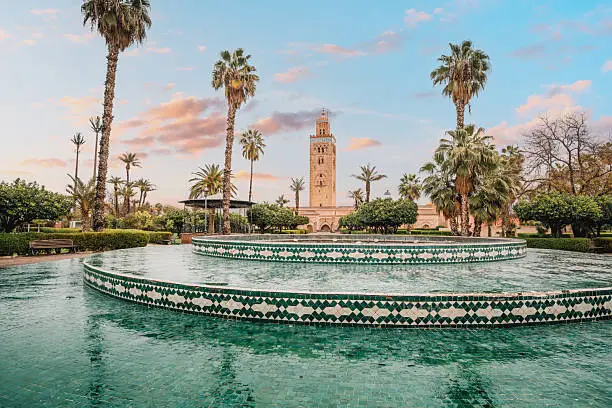
The Koutoubia Mosque minaret is the most recognizable landmark in Marrakech, visible from almost every rooftop in the medina.
The souks north of Djemaa el-Fna are organized by trade in a way that has not changed in centuries. The leather souk, the spice souk, the carpet souk, the brass and copper souk. Each section has its own smells and sounds and rhythm. Getting lost in the souks is not a problem to be solved but an experience to be had.
The most useful thing to know before entering the souks is that prices are always negotiable and the first price quoted is rarely the actual price. A friendly counter-offer of around half the asking price is the standard starting point. Walking away is a legitimate tactic. The whole process is more playful than adversarial once you understand the rules.
The Majorelle Garden in the Gueliz new town was created by French painter Jacques Majorelle in the 1920s and restored by Yves Saint Laurent after his purchase of the property in 1980. The garden is a sanctuary of exotic plants, cobalt blue architecture, and calm that feels completely removed from the medina noise outside its walls.
The adjacent Berber Museum, housed in Majorelle’s original studio, contains an excellent collection of Moroccan Berber jewelry, textiles, and decorative objects. The YSL Museum across the street is worth an hour for anyone interested in fashion or 20th-century design.
- Opening hours: daily from 8am to 5:30pm (extended hours in summer)
- Entry: approximately 150 MAD (around $15)
- Book tickets online to avoid queuing
The Bahia Palace was built in the late 19th century for a grand vizier of the sultan and gives the most accessible impression of the scale and ambition of traditional Moroccan palatial architecture. The interconnected courtyards, painted cedar ceilings, and intricate zellij tilework are extraordinary, and the palace is less crowded than most major Marrakech sites.
The Saadian Tombs, sealed for two centuries after the death of the Saadian dynasty and rediscovered in 1917, contain some of the finest decorative work in Morocco. The chamber of the twelve columns, with its carved stucco walls and painted cedar ceiling, is genuinely breathtaking. Arrive early to avoid the longest queues.
Visiting a traditional hammam is one of the most authentically Moroccan experiences available in Marrakech. The process involves steam, black soap (savon beldi), and a vigorous scrub (kessa) that removes dead skin and leaves you feeling completely renewed. Most riads can arrange a visit to a local hammam rather than a tourist spa, which is both cheaper and more genuine.
The neighborhood hammam experience costs around 20 to 30 MAD (roughly $2 to $3) plus a small tip for the attendant. Bring a towel, flip flops, and a change of clothes. The hammam is not only a hygiene facility but a deeply social institution where locals gather and conversations happen across generations.
The choice of where to stay in Marrakech is one of the most important decisions of the trip. The two main options are the medina and the Gueliz new town, and they offer fundamentally different experiences.
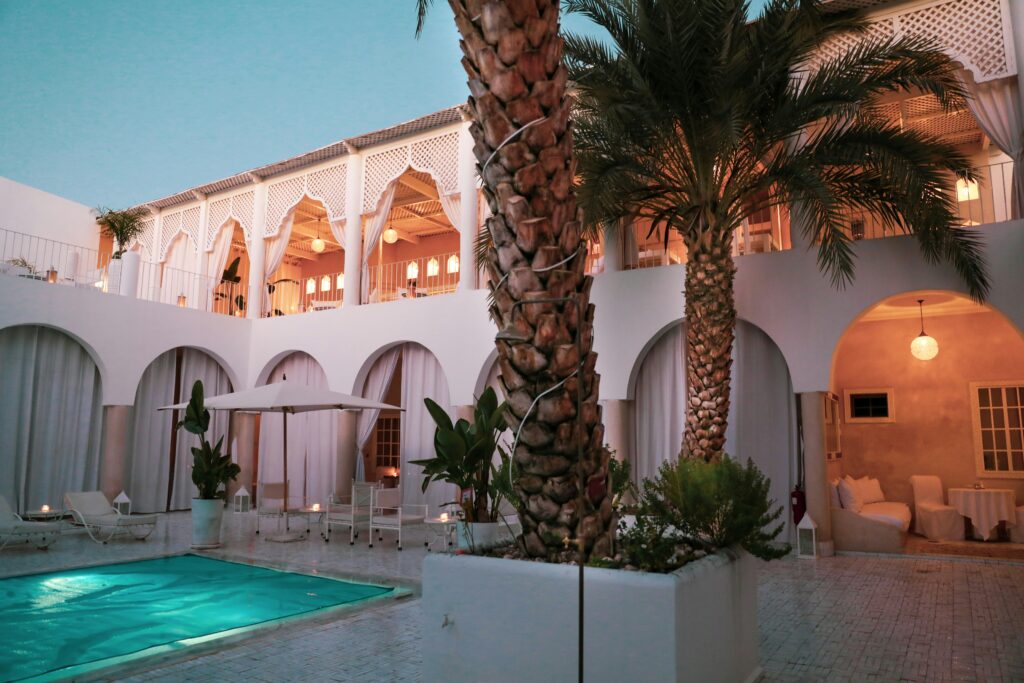
A riad is a traditional Moroccan house built around a central courtyard, often with a fountain and planted garden. Staying in a well-chosen riad inside the medina walls is the definitive Marrakech accommodation experience. The exterior gives almost nothing away and the interiors are often extraordinary, with hand-painted ceilings, mosaic floors, and rooftop terraces overlooking the medina landscape.
Riads range from small family-run guesthouses at $50 per night to lavishly restored properties at $500 or more. The best riads in the medina book out months in advance, particularly for October and March visits. Book directly with the riad when possible for better rates and more personal service.
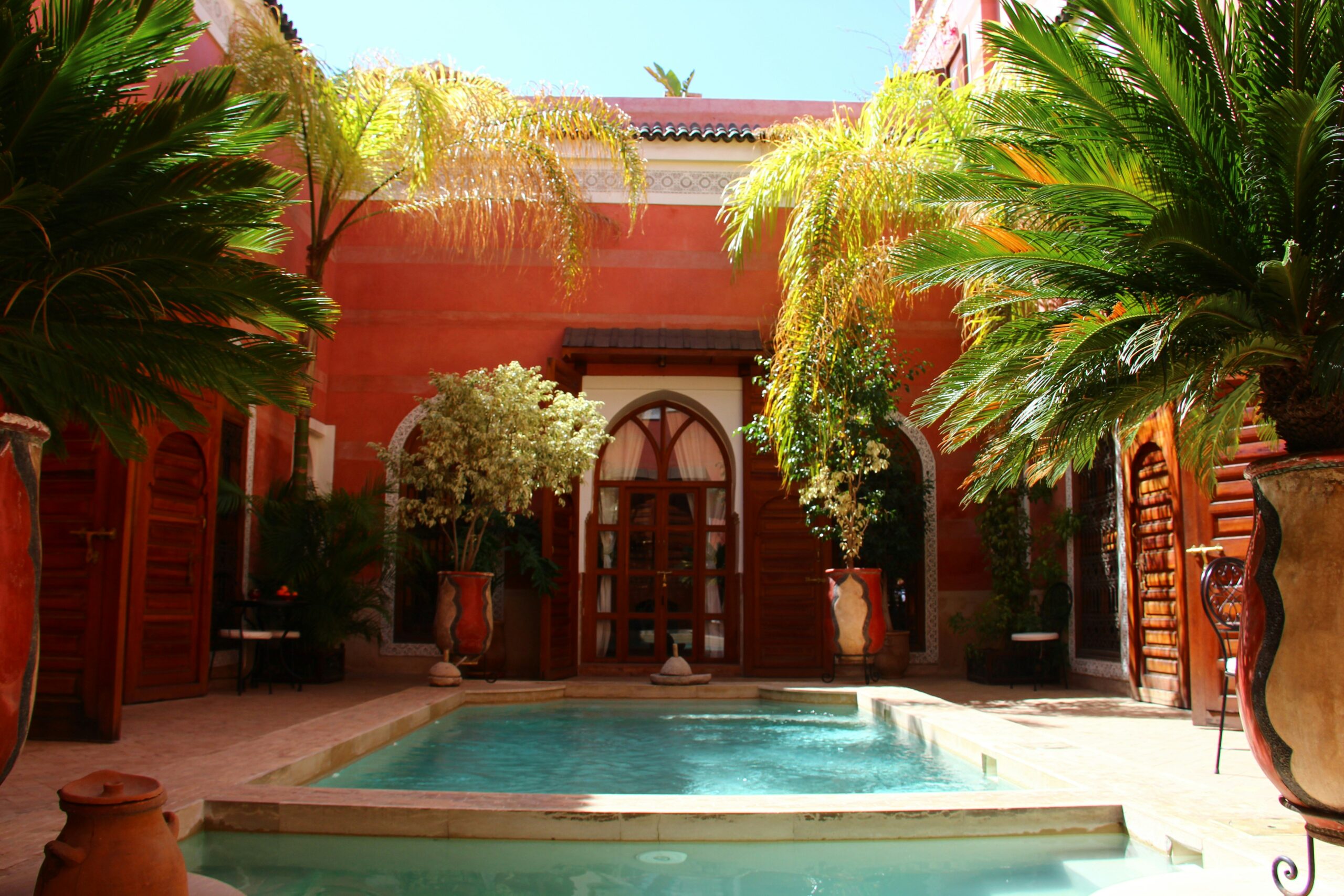
A traditional Marrakech riad: ochre walls, central courtyard pool, and palm trees. The interiors are almost always more beautiful than the medina exterior suggests.
The Gueliz district is Marrakech’s modern French-built neighborhood, with wide tree-lined boulevards, international restaurants, and a more relaxed atmosphere than the medina. Hotels here are typically easier to reach by taxi and better suited for travelers who find the medina intensity difficult to manage. The trade-off is losing the immersive quality of waking up inside the ancient city.
- Tagine: slow-cooked stew in a conical clay pot. Lamb with prunes and almonds, or chicken with preserved lemon and olives
- Couscous: traditionally served on Fridays, the Moroccan version bears no resemblance to the instant variety
- Harira: a thick tomato and lentil soup with coriander, traditionally served to break the Ramadan fast
- Pastilla: a flaky pastry pie filled with pigeon or chicken and almonds, dusted with icing sugar
- Mechoui: whole slow-roasted lamb, sold by weight from large underground ovens in the medina
- Mint tea: poured from height into small glasses, intensely sweet, and served at the start and end of almost every social interaction
The High Atlas Mountains begin less than an hour south of Marrakech and offer a completely different Morocco from the urban medina. The Ourika Valley is the most accessible day trip destination, with Berber villages, terraced fields, and the Setti Fatma waterfalls at the end of a walk through the valley. Toubkal National Park, home to North Africa’s highest peak at 4,167 meters, is reachable for an overnight or multi-day trekking trip.
The UNESCO-listed ksar of Ait Benhaddou is a 3-hour drive south of Marrakech over the Tizi n’Tichka mountain pass. The fortified mud-brick village has served as a film location for Gladiator, Game of Thrones, and dozens of other productions. The drive over the pass through Berber villages and mountain scenery is itself worth the journey. Best combined with a night in Ouarzazate for those with more time.
Essaouira on the Atlantic coast is 3 hours from Marrakech by CTM bus or private transfer and offers a complete change of atmosphere. The walled medina is UNESCO-listed, the food scene is excellent (particularly the fresh seafood grilled on the harbor), and the wind that makes the town famous among kitesurfers also keeps temperatures significantly cooler than Marrakech in summer.
| Period | Temperature | Crowds | Notes |
|---|---|---|---|
| March to May | 18 to 26 degrees C | Moderate | Best weather, flowers blooming |
| June to August | 35 to 42 degrees C | Low | Very hot, outdoor sightseeing difficult at midday |
| September to November | 20 to 30 degrees C | Moderate | Excellent conditions, good prices |
| December to February | 8 to 18 degrees C | Low | Cool evenings, cheapest rates, atmospheric |
March to May and September to November are the best times to visit Marrakech. Spring brings pleasant temperatures and manageable crowds. Autumn is similarly comfortable with the added benefit of slightly lower prices than spring. Summer is genuinely hot and best avoided for intensive medina exploration, though the city comes alive in the evenings when temperatures drop.
- Save your riad address in Arabic on your phone: essential for navigating back through the medina or directing taxi drivers
- Carry small change: exact change is useful in local restaurants and for tips
- Dress modestly in the medina: covering shoulders and knees is respectful and reduces unwanted attention
- Use petit taxis within the city: always agree on the price before getting in or insist on the meter
- Book popular riads directly: you often get better rates and the owner’s personal attention
- Learn a few phrases in French or Darija: even minimal effort is genuinely appreciated
Marrakech is a city that requires surrender. The travelers who try to control the experience, who resist getting lost, who avoid anything that feels unfamiliar, tend to find it overwhelming. The ones who lean into the chaos, take wrong turns, accept a glass of mint tea from a shopkeeper with no obligation to buy, and let the medina set the pace, tend to describe it as one of the most extraordinary places they have ever been.
This Marrakech travel guide gives you the context to navigate the city confidently. The rest is up to the city itself, which has been doing this for a thousand years and has no shortage of things to show you.
Ready to Plan Your Marrakech Trip?
Discover more Morocco guides, destination tips, and travel itineraries on Tripfavor.
Explore Tripfavor →