
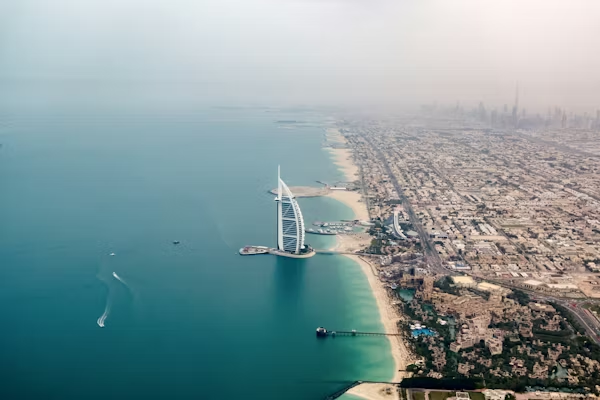
Dubai Travel Guide: Everything You Need to Know
Dubai is one of the most extraordinary cities built in the last fifty years. What was a small pearl-fishing settlement in the 1960s is now a global metropolis of glass towers, artificial islands, and world records. The tallest building on earth, the largest shopping mall, the longest automated metro system in the world. Dubai does nothing in half measures.
This Dubai travel guide covers everything first-time visitors need to know: what to see, where to eat, how to get around, the best time to visit, what to expect culturally, and why the desert just outside the city is as compelling as the skyline within it.
Dubai occupies a unique position in global travel. It is simultaneously ultramodern and rooted in Emirati and Islamic tradition. The contrast between the historic Al Fahidi district and the futuristic towers of Downtown Dubai, between a traditional gold souk and a ski slope inside a shopping mall, is what makes the city genuinely interesting rather than simply spectacular.
The city has also positioned itself as a hub for travelers connecting between Europe, Asia, and Africa, which means extraordinary flight connectivity and a tourism infrastructure that handles millions of visitors with remarkable efficiency. According to Dubai’s official tourism website, the emirate welcomed over 17 million international overnight visitors in 2023, making it one of the most visited cities on earth.
The Burj Khalifa stands at 828 meters and remains the tallest building in the world. The observation deck on the 124th floor gives a view of Dubai that is genuinely vertiginous: the desert stretching to one horizon, the Gulf glittering to the other, and the city laid out below in a scale that only makes sense from this height.
Book tickets online well in advance, particularly for the sunset time slots which sell out days ahead. The At the Top Sky experience on the 148th floor costs more but is significantly less crowded. The Dubai Fountain show in the lake below the tower runs every evening and is free to watch from the surrounding boardwalk.
- At the Top (124th floor): from AED 149 (approximately $40)
- At the Top Sky (148th floor): from AED 379 (approximately $103)
- Best time: 30 minutes before sunset for the light transition
The Al Fahidi Historical Neighbourhood in Bur Dubai is the oldest surviving part of the city, with narrow wind-tower architecture and courtyard houses that predate the oil era by generations. The Dubai Museum inside Al Fahidi Fort gives an excellent overview of how the city transformed from a fishing village to a global metropolis in a single lifetime.
A short abra (traditional wooden boat) ride across the Dubai Creek takes you to Deira, where the Gold Souk and Spice Souk operate much as they have for decades. The Gold Souk alone contains over 300 retailers and more gold on display than most national banks hold in reserve. The Spice Souk fills the surrounding streets with the smell of frankincense, saffron, and dried rose petals.
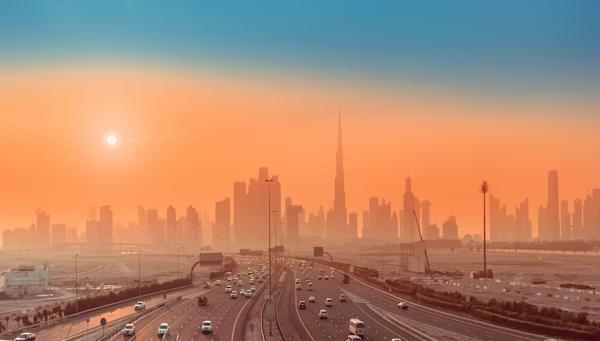
Dubai’s skyline from the waterfront. The Burj Khalifa dominates the centre while the city stretches in every direction across reclaimed land and desert.
The Dubai Frame is a 150-meter picture frame structure that frames old Dubai on one side and new Dubai on the other from the same vantage point. The glass-floored sky bridge connecting the two towers gives a view that neatly encapsulates the city’s identity: heritage and ambition facing each other across a single threshold.
The Museum of the Future, completed in 2022, is one of the most architecturally striking buildings in the world and contains an immersive exploration of what human life, technology, and cities might look like in 2071. The building itself, a torus-shaped structure covered in Arabic calligraphy, is worth visiting as a piece of architecture even before you enter.
Dubai Marina is a purpose-built canal city with 200 towers rising around a 3-kilometer artificial waterway. The Marina Walk is one of the best places in Dubai to eat, people-watch, and understand the lifestyle the city has built for its international resident population. Restaurants from every cuisine line the waterfront and the yachts moored in the canal are a spectacle in their own right.
Jumeirah Beach Residence (JBR) just west of the marina has a wide public beach, a pedestrianized retail strip called The Walk, and some of the most accessible beach club access in Dubai. The water is warm, the sand is clean, and the backdrop of towers behind the beach gives the characteristic Dubai visual contrast that never quite gets old.
A desert safari is the experience that surprises most Dubai visitors. Thirty minutes outside the city, the landscape shifts completely into the rust-colored dunes of the Arabian Desert. An evening desert safari typically includes dune bashing in 4×4 vehicles, sandboarding, camel riding, and a dinner in a Bedouin camp under a sky filled with stars that is invisible from the city.
Overnight desert safaris allow you to experience the desert at dawn, when the light on the dunes is extraordinary and the silence is total. This is genuinely one of the best experiences available in the UAE and represents a completely different Dubai from the one most visitors expect.
- Evening desert safari: from AED 200 per person (approximately $55)
- Overnight desert camp: from AED 500 per person (approximately $136)
- Private desert experiences: from AED 1,200 per person
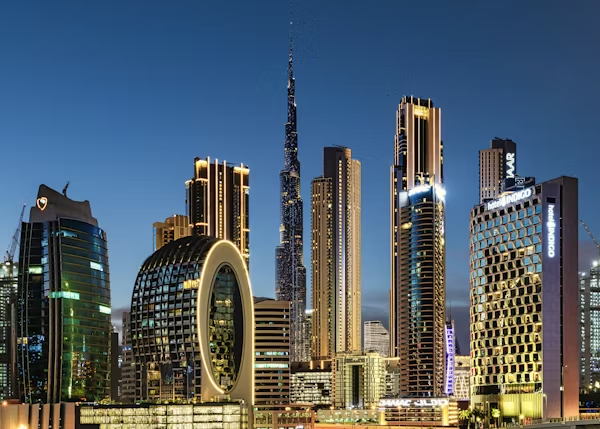
The Arabian Desert begins just 30 minutes outside Dubai. The contrast between the city skyline and these dunes is one of the most striking things about visiting the UAE.
Downtown Dubai is where the Burj Khalifa, Dubai Mall, and Dubai Fountain are located. It is the most recognizable part of the city and the logical starting point for first-time visitors. The area is well connected by metro and the walkways between major attractions are pleasant in the cooler months. It is expensive but accessible at every budget level through the public spaces and free attractions.
These two neighborhoods on either side of Dubai Creek represent the city before the oil era. Walking through Al Fahidi and crossing to Deira by abra gives the most complete picture of what Dubai was and how quickly it changed. Significantly less expensive than the newer districts and more interesting for travelers who want cultural depth alongside the spectacle.
The Marina and Palm Jumeirah are where Dubai’s international lifestyle is most concentrated. Restaurants, beach clubs, luxury hotels, and water sports define both areas. The Palm Monorail and Palm Jumeirah boardwalk give access to the artificial island’s hotels and beach restaurants. The view of the Dubai skyline from the Palm at sunset is one of the best in the city.
Dubai’s food scene reflects its population: over 90 percent of the city’s residents are expatriates, and the restaurant landscape represents this diversity extraordinarily well. Every cuisine from every region of the world is available at every price point.
- Shawarma: the street food of Dubai, available from small cafes throughout Deira and Bur Dubai for AED 5 to 15
- Al Harees: a traditional Emirati dish of slow-cooked wheat and meat, served at Ramadan and on special occasions
- Luqaimat: fried dough balls drizzled with date syrup and sesame, sold from street carts particularly in the old city
- Mezze: the Lebanese and Levantine tradition of small shared dishes is embedded in Dubai’s dining culture at every price level
- Fresh seafood: the fish market in Deira sells the morning’s catch and several nearby restaurants will cook your purchase for a small fee
| Period | Temperature | Crowds | Notes |
|---|---|---|---|
| November to March | 18 to 28 degrees C | High | Best weather, peak tourist season |
| April to May | 28 to 37 degrees C | Moderate | Warming up, good value |
| June to September | 38 to 45 degrees C | Low | Extreme heat, indoor activities only |
| October | 30 to 38 degrees C | Moderate | Transition month, reasonable prices |
November to March is the best time to visit Dubai. Temperatures are warm but manageable, outdoor attractions are fully accessible, and the city is at its most alive. The Dubai Shopping Festival runs annually from December and adds a festive energy to an already vibrant city.
Summer in Dubai (June to September) is genuinely extreme. Temperatures regularly exceed 42 degrees Celsius with high humidity. Outdoor sightseeing is limited to early morning and evening hours. However, this is when hotels offer their lowest rates of the year, and the indoor attractions including malls, aquariums, and museums are all fully air-conditioned and very accessible.
- Dress modestly in public spaces: while Dubai is tolerant of Western dress in tourist areas, covering shoulders and knees in malls, souks, and religious sites is respectful and expected
- Use the Metro: the Dubai Metro is clean, cheap, and connects most major attractions. The Red Line covers Downtown, Marina, and the airport
- Carry cash for souks and local restaurants: the Gold Souk and Spice Souk traders prefer cash and prices are negotiable
- Respect Ramadan if your visit coincides: eating and drinking in public during daylight hours is restricted. Many restaurants close during the day but open after sunset with a festive atmosphere
- Book popular restaurants in advance: the best restaurants in Dubai fill weeks ahead, particularly weekend dinner slots
- Uber and Careem both work well: taxis are also reliable but Uber gives price certainty before you book
Dubai rewards travelers who engage with its contradictions rather than trying to resolve them. The city is simultaneously a monument to human ambition and a place where ancient trading traditions still operate from the same creek they always did. The towers and the desert exist thirty minutes apart and both are extraordinary.
This Dubai travel guide gives you the context to navigate both sides of the city. The rest is a matter of showing up and letting one of the world’s most improbable cities do what it does best.
Ready to Plan Your Dubai Trip?
Discover more Middle East guides, destination tips, and travel itineraries on Tripfavor.
Explore Tripfavor →