
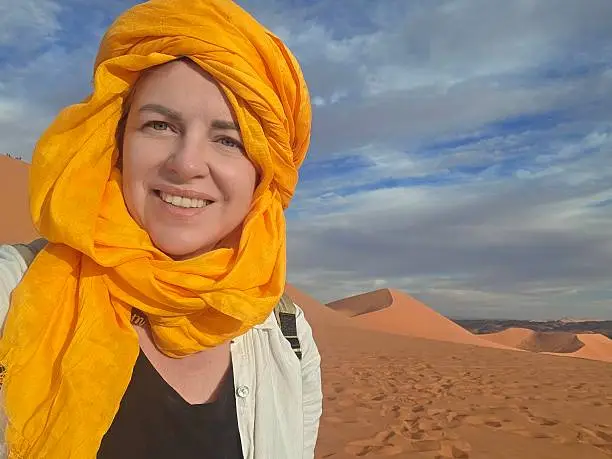
The Sahara Desert is the largest hot desert on earth, stretching across eleven countries and covering an area roughly the size of the United States. For most travelers, experiencing the Sahara means Morocco, and more specifically the extraordinary dune fields of Erg Chebbi near Merzouga in the south of the country. These dunes rise to over 150 meters and turn deep amber at sunset in a way that no photograph fully captures.
This Sahara Desert travel guide covers everything you need to plan a trip to the desert: the best entry points, how to choose between budget and luxury camps, the camel trekking experience, stargazing, what to pack, and the practical details that make the difference between a good desert trip and one you spend the rest of your life talking about. If you’re combining the desert with the rest of the country, our Morocco 7-day itinerary covers the full Marrakech to Sahara route.
Quick Answer: Sahara Desert Travel Guide
The Sahara rewards travelers with experiences that exist nowhere else. The silence of the desert at night is absolute in a way that most people have never experienced. The stars over Erg Chebbi, far from any city light, are dense enough to cast faint shadows. The light on the dunes at dawn shifts from cold blue-grey to pale gold to deep amber in the space of thirty minutes.
Beyond the sensory experience, the Sahara offers a genuine encounter with Berber culture. The guides who lead camel treks through the dunes are from families that have navigated this landscape for generations. The tea ceremony inside a desert camp, conducted with the same ritual it has been for centuries, is one of those travel moments that stays with you. According to UNESCO, the Sahara landscape and its associated Berber cultural heritage represent some of the most significant natural and cultural assets in North Africa.
Merzouga is the most accessible gateway to the Sahara dunes and the starting point for the vast majority of desert visits from Morocco. The village sits at the edge of Erg Chebbi, a sea of dunes covering roughly 50 square kilometers with peaks reaching 150 meters. The infrastructure for tourism is well developed without being overwhelming, and the quality of camps ranges from basic to genuinely extraordinary.
Most travelers reach Merzouga as part of the classic Marrakech to Sahara road trip, passing through the High Atlas Mountains, Ait Benhaddou, and the Draa Valley. The journey is as much a part of the experience as the destination. A driver for the full route is straightforward to book ahead through GetTransfer.com.
- Distance from Marrakech: approximately 560 km (7 to 8 hours by road)
- Distance from Fes: approximately 370 km (5 to 6 hours by road)
- Best arrived at: late afternoon to catch the dunes at golden hour
Zagora in the Draa Valley offers access to Erg Chigaga, a more remote and less visited dune system in the far south of Morocco. Erg Chigaga requires a 4×4 transfer across open desert to reach and sees a fraction of the visitors that Erg Chebbi attracts. The camps here tend to be smaller, the silence deeper, and the feeling of genuine remoteness more pronounced.
Zagora is a better choice for travelers who have already visited Merzouga and want a more solitary desert experience, or for those who prioritize authenticity over convenience.
Douz in southern Tunisia is known as the gateway to the Sahara on the Tunisian side. The dune landscape is different from Morocco’s Erg Chebbi, flatter and more accessible, but the surrounding oasis towns of Nefta and Tozeur offer a compelling combination of desert and traditional Tunisian architecture. Douz hosts an annual international Sahara festival in December.
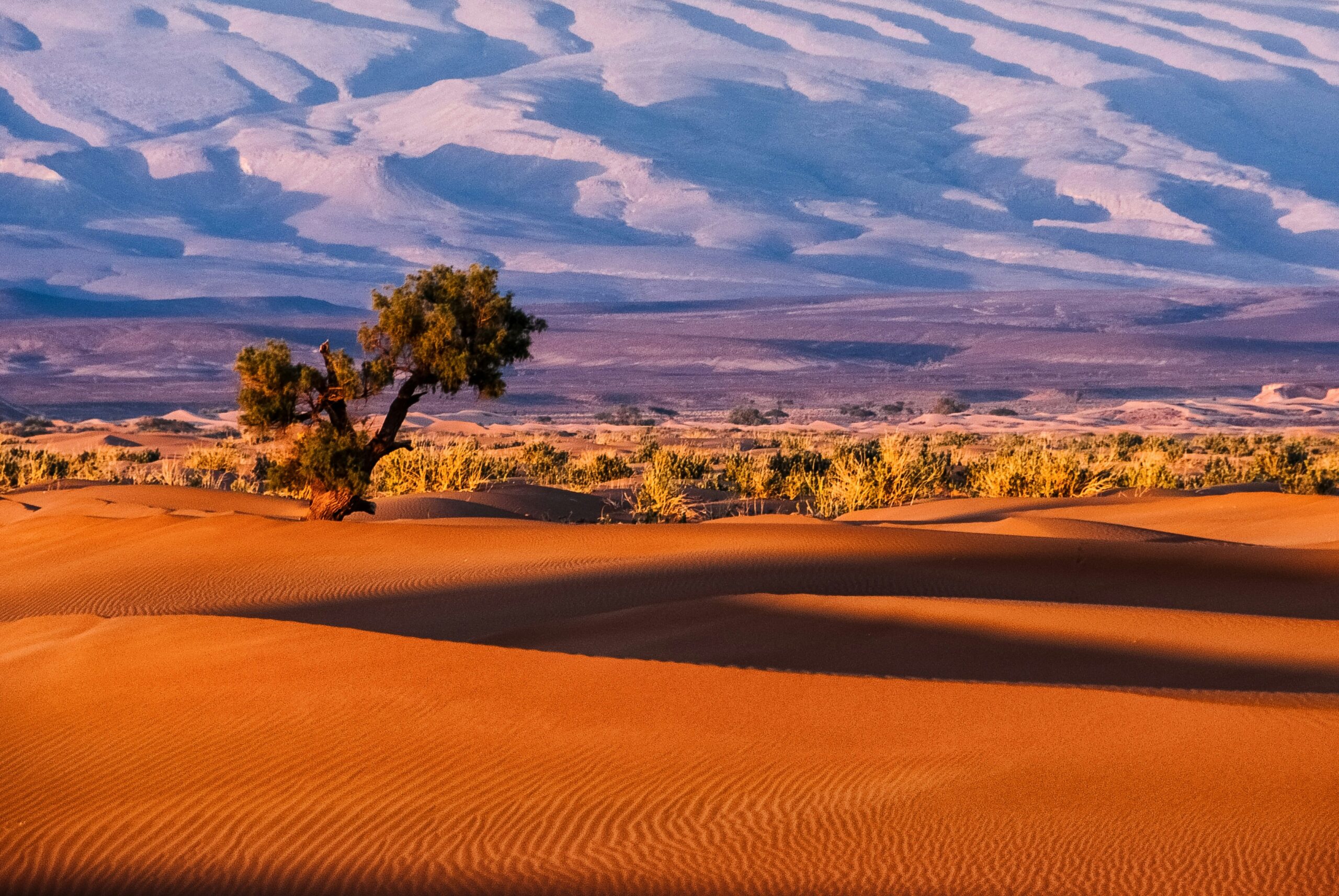
The Sahara at golden hour. The light on the dunes shifts from pale gold to deep amber in the thirty minutes before sunset, then fades to a violet blue that lasts until dark.
Sleeping in the desert is the heart of the Sahara experience. Camps range from basic shared tents with sleeping bags to luxury structures with proper beds, electricity, private bathrooms, and catered dinners. The choice depends entirely on what you want from the night.
Budget camps offer traditional Berber-style tents with mattresses and blankets, shared bathroom facilities, and a communal dinner around a fire. The stargazing is identical to a luxury camp and the camel trek access is the same. What you sacrifice is private space and the quality of the food and bedding. For travelers who prioritize the experience over the comfort, budget camps deliver everything that matters.
Most budget camps are booked through guesthouses in Merzouga village. Prices typically include the camel trek to the camp, dinner, breakfast, and the return trek at dawn.
Luxury desert camps have transformed the Sahara experience into something that rivals the finest hotel stays in the world. Private tent suites with proper beds, electricity, hot showers, and en-suite bathrooms sit within full sight of the dunes. Gourmet Moroccan dinners are served under the stars. Some camps include private guides, yoga sessions at dawn on the dunes, and spa treatments.
Camps like Scarabeo Camp, Luxury Camp Erg Chebbi, and Dar Azawad are among the most celebrated desert accommodation experiences in Africa. These camps book out many months in advance for peak season dates between October and April.
The camel trek into the dunes is the standard way to reach a desert camp and one of the most iconic travel experiences in Morocco. The typical evening trek takes around 45 minutes to an hour from the edge of the dunes to the camp, riding in single file as the dunes rise around you and the village behind disappears completely.
Dawn treks back from camp are shorter and accompanied by the extraordinary light of the Sahara sunrise. Most travelers describe the pre-dawn climb to the top of a nearby dune to watch the sun rise over the desert as the best single moment of their trip.
A typical Sahara overnight unfolds in this order:
- Arrive at the desert base camp in the late afternoon, ahead of golden hour
- Camel trek into the dunes — 45 minutes to an hour, timed to reach camp for sunset
- Dinner and a Berber tea ceremony around the fire at camp
- Stargazing once full dark sets in, ideally near a new moon
- Pre-dawn dune climb to watch the sunrise from a high point above camp
- Camel trek back to the village in the cool of early morning
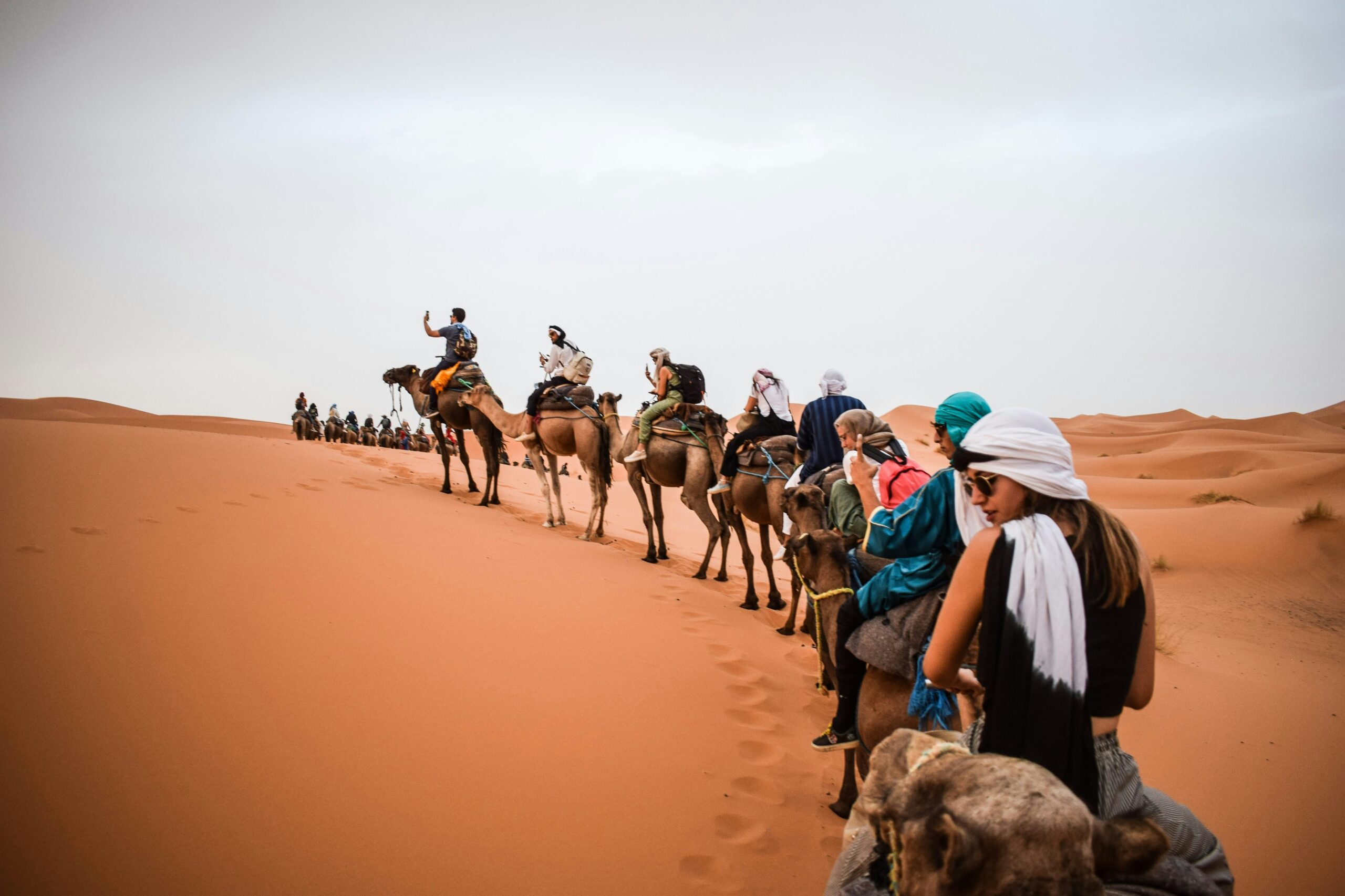
A camel caravan crosses Erg Chebbi toward the desert camps. The trek takes around an hour and the landscape changes completely as the dunes close in around the group.
The Sahara is one of the best places on earth for stargazing. The combination of zero light pollution, dry air with minimal humidity, and clear skies for most of the year creates conditions for astronomical observation that few other accessible locations can match.
The Milky Way is visible as a dense band across the sky on clear nights, bright enough to create faint shadows on the sand. Shooting stars are frequent. In a clear night between October and April, the sky above Erg Chebbi contains more visible stars than most people have ever seen in their lives. This alone is worth the journey for many visitors.
| Period | Daytime Temp | Night Temp | Notes |
|---|---|---|---|
| October to November | 25 to 32 degrees C | 10 to 15 degrees C | Ideal conditions, golden light |
| December to February | 18 to 25 degrees C | 2 to 8 degrees C | Cold nights, incredible stars, few tourists |
| March to April | 25 to 35 degrees C | 12 to 18 degrees C | Excellent conditions, busier |
| May to September | 38 to 48 degrees C | 22 to 30 degrees C | Extreme heat, not recommended |
October to April is the recommended window for visiting the Sahara. October and November offer the most balanced conditions: warm days, cool evenings, clear skies, and manageable crowds. December and January are cold at night (temperatures can drop close to freezing) but the skies are exceptional and the dunes are virtually empty of other visitors. See our full best time to visit Morocco guide for how this fits into a wider trip.
Summer desert visits (June to August) are genuinely dangerous for extended outdoor activity. Temperatures regularly exceed 45 degrees Celsius and the heat makes camel trekking and dune climbing extremely hazardous. This season is best avoided entirely.
- A warm layer for desert nights: even in October, temperatures drop significantly after sunset. A fleece or down jacket is essential
- A scarf or shemagh: protects against wind-blown sand and sun. Berber guides wear them year-round for good reason
- Closed shoes for dune climbing: sandals fill with sand immediately and make climbing difficult
- Sunscreen and sun protection: the desert sun is intense and reflection from the sand amplifies UV exposure significantly
- A camera with a wide angle lens: the landscape demands wide-angle perspective. The dunes are larger than any telephoto can convey
- Reusable water bottle: stay hydrated throughout the day. Drink more than you think you need
- Headtorch: essential for moving around camp at night and for dawn dune climbs
- Cash: tips for camel guides, camp staff, and local purchases are all cash transactions
The Sahara Desert is one of those destinations that changes people. Not in a dramatic way but in a quiet one. The scale of the landscape recalibrates your sense of proportion. The silence teaches you what silence actually sounds like. The stars remind you of something you did not know you had forgotten.
Plan carefully, choose your camp based on what matters most to you, arrive in the late afternoon, and stay for at least one full night. The Sahara will take care of the rest.
Ready to Plan Your Sahara Trip?
Discover more Morocco guides, desert tips, and travel itineraries across Africa on Tripfavor.
Explore Tripfavor →