
Angkor Wat Travel Guide: Everything You Need to Know
Angkor Wat is the largest religious monument ever built and one of the most extraordinary archaeological sites on earth. The temple complex near Siem Reap in northwestern Cambodia was constructed in the 12th century as the state temple of the Khmer Empire and covers an area of 400 acres, making it larger than medieval Rome at the time of its construction.
This Angkor Wat travel guide covers everything visitors need to know: how to explore the complex, which temples to prioritize beyond the main structure, how to experience sunrise, what tickets cost, the best time to visit, and the practical details that determine whether a trip to Angkor is genuinely transformative or simply exhausting in the heat.
Angkor Wat is not one temple. It is a city. The Angkor Archaeological Park covers 400 square kilometers and contains dozens of major temple complexes built by successive Khmer kings between the 9th and 15th centuries. The main Angkor Wat temple is the most famous and most visited, but the surrounding park contains structures of equal architectural ambition and, in some cases, considerably more atmospheric power.
According to UNESCO’s World Heritage listing, Angkor is recognized as one of the most important archaeological sites in Southeast Asia, with the remains of the different capitals of the Khmer Empire from the 9th to 15th centuries representing one of the most extraordinary concentrations of monumental architecture anywhere on earth.
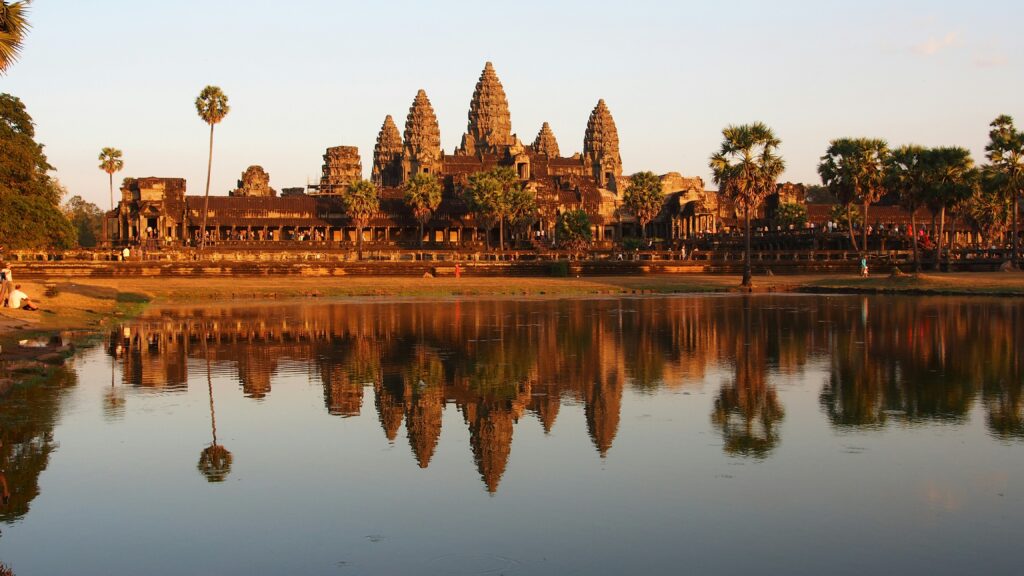
The main Angkor Wat temple faces west, which is unusual among Khmer temples and creates the famous reflection in the western pond at sunrise. The temple rises in three concentric rectangular galleries to a central tower 65 meters high, representing Mount Meru, the home of the gods in Hindu cosmology. The bas-relief galleries on the outer wall cover 800 meters and depict scenes from Hindu mythology and Khmer military history with extraordinary detail.
Allow a minimum of three hours for a thorough exploration of the main temple. The inner sanctuary requires climbing steep stairs and is best attempted in the early morning before the heat builds. The bas-relief galleries are best viewed in the morning light when the carved details are most visible.
- Best time: arrive before 5:30am for sunrise, or after 3pm when tour groups thin
- Time needed: 3 to 4 hours minimum for the main temple alone
- Dress code: shoulders and knees covered throughout the complex
Angkor Thom is the walled capital city built by King Jayavarman VII in the late 12th century, covering 9 square kilometers and entered through five massive gates, each surmounted by four giant stone faces. The South Gate, with its flanking rows of gods and demons carrying a giant naga serpent, is one of the most dramatic entrances in all of archaeology.
At the center of Angkor Thom stands the Bayon, a temple of 54 towers each bearing four enormous stone faces gazing in the cardinal directions. Over 200 faces total look out from the Bayon in an effect that is simultaneously serene and overwhelming. The bas-reliefs here depict scenes of everyday Khmer life rather than mythology, making them uniquely human in character among Angkor’s temples.
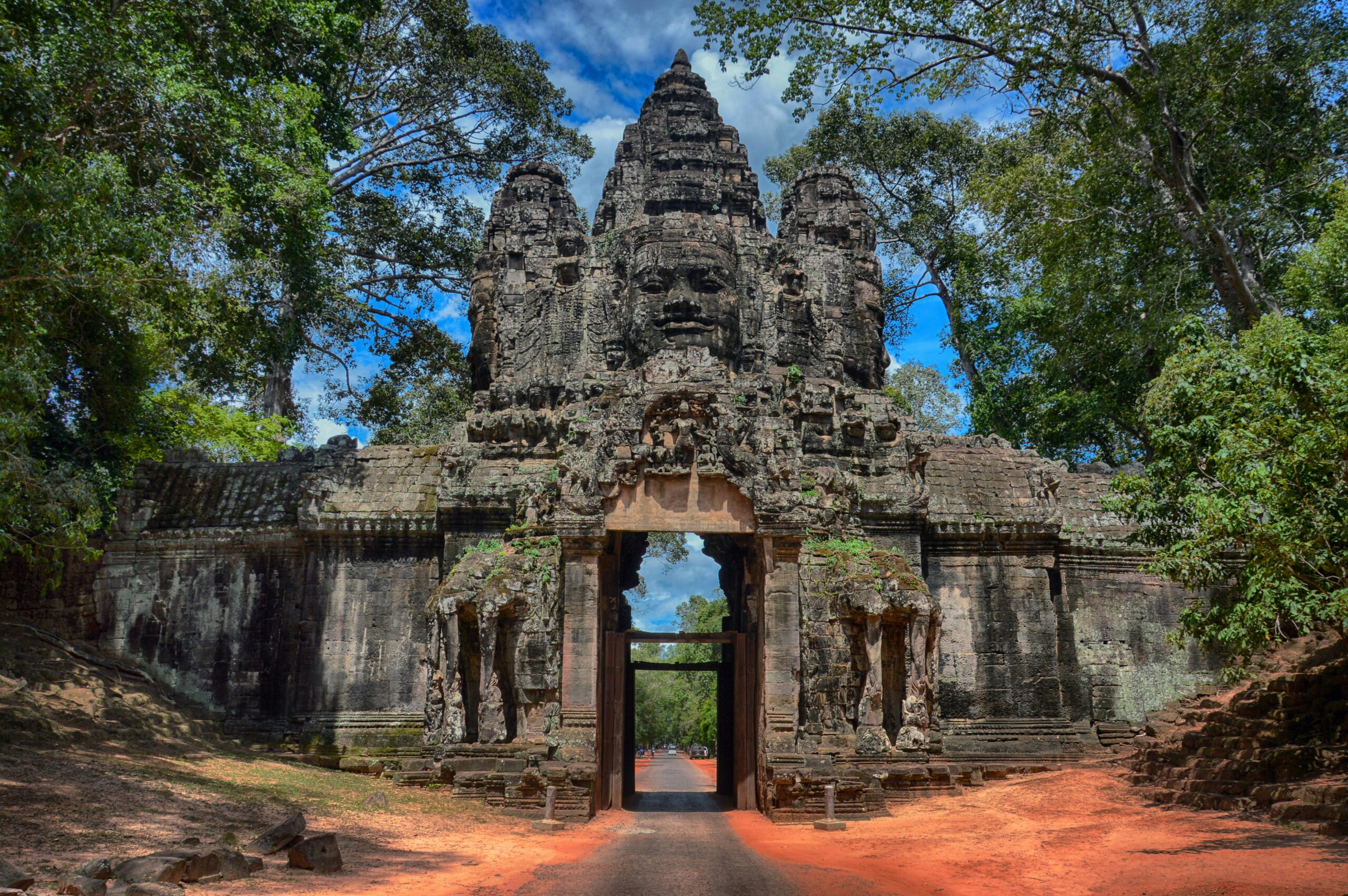
The main causeway approaching Angkor Wat from the west. The temple rises beyond the palm-lined approach in a sequence that was designed to build anticipation across the 250-meter walk from the outer gate.
Ta Prohm is the temple where the jungle has been deliberately left to grow through the stone, creating the most dramatically atmospheric site in the entire park. Giant strangler figs and silk cotton trees have split walls, lifted roofs, and wrapped their roots around towers over the 500 years since the temple was abandoned. The result is a place that looks more like a film set than an archaeological site, which is perhaps why it was used as one for Tomb Raider.
Ta Prohm is genuinely extraordinary but is also the most crowded temple in Angkor after the main Wat. Visit at opening time (7:30am) or late afternoon to experience it without competing for space at the famous tree-root photo spots. The temple closes at 5:30pm.
Banteay Srei, 25 kilometers north of the main complex, is built from pink sandstone rather than the grey laterite of the main Angkor temples, and the quality of its carved decoration is considered the finest of any Angkor period temple. The scale is intimate compared to the massive structures of the main complex, which allows the eye to focus on the extraordinary detail of the pediments, lintels, and pilasters.
Banteay Srei requires a separate half-day trip from Siem Reap but is worth every kilometer. Combining it with the nearby Kbal Spean river carvings, where Hindu iconography has been carved into the riverbed itself, makes a particularly rewarding day away from the main tourist circuit.
Pre Rup is a pyramid temple on the eastern edge of the main complex that provides the best accessible sunset viewpoint in the park. Climbing to the upper terrace in the late afternoon gives views over the surrounding jungle canopy as the light turns golden. The temple sees far fewer visitors than Angkor Wat’s western pond at the same time of day.
The outer temples of the Angkor complex including Neak Pean, Ta Som, and East Mebon reward travelers who move beyond the standard circuit. Each has distinctive architectural features and all see significantly fewer visitors than the main sites.
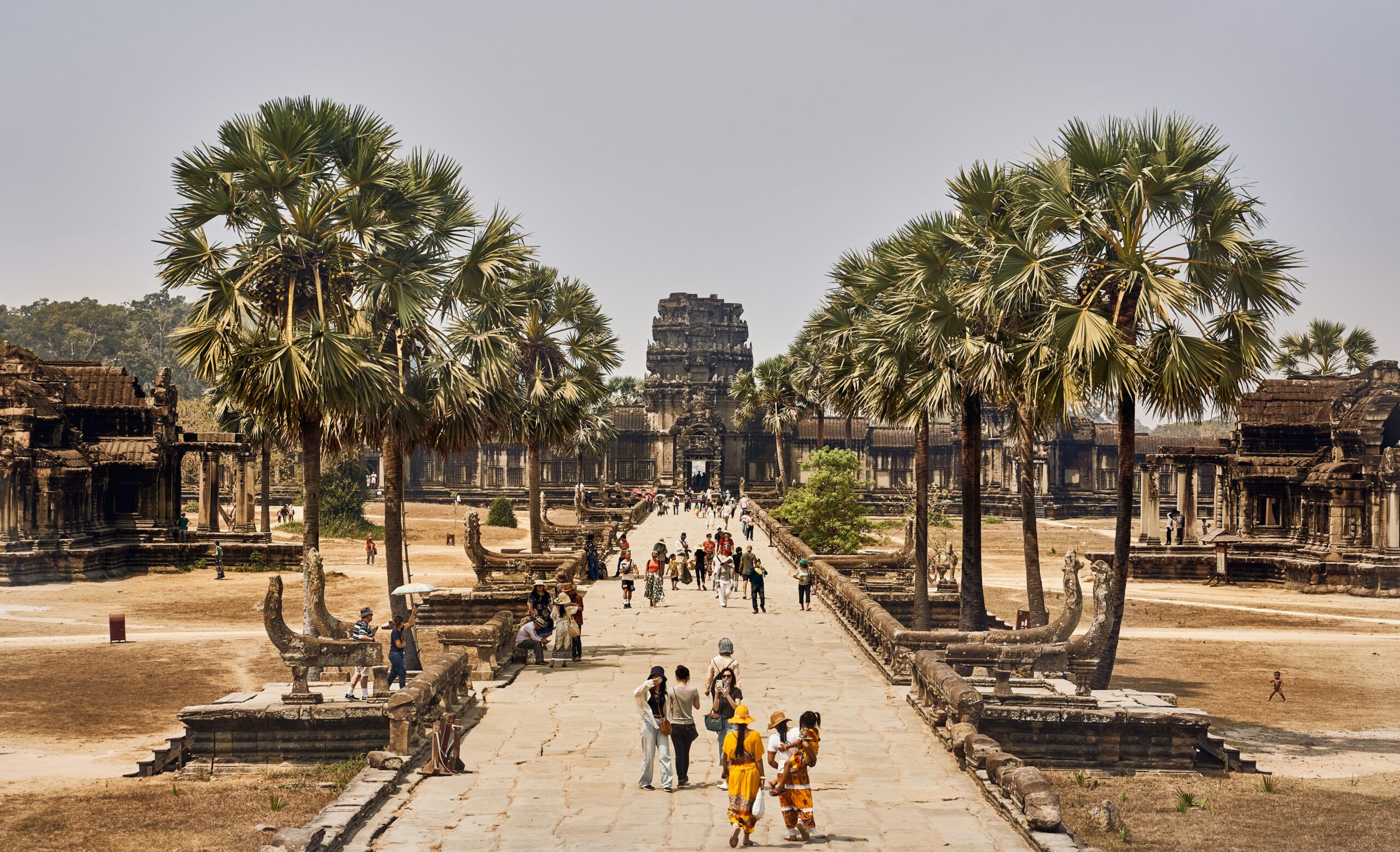
The South Gate of Angkor Thom, built in the late 12th century. Four giant stone faces gaze in the cardinal directions from each of the five gates surrounding the ancient Khmer capital.
Sunrise at Angkor Wat is one of the most celebrated travel experiences in Southeast Asia. The temple faces west, which means the eastern sky behind it turns orange and red at dawn while the temple itself reflects in the western pond in front of it. The combination is genuinely extraordinary.
- Arrive by 5:15am: the park gates open at 5am and the best reflection pond positions are taken quickly
- Crowds are significant: sunrise at Angkor Wat draws hundreds of photographers and visitors every morning. The experience is still worth it but manage expectations about solitude
- Your ticket is valid from the previous evening: you can purchase your pass the afternoon before and use it for sunrise the next morning without an additional purchase
- Alternative sunrise spots: Srah Srang reservoir, Pre Rup, and Phnom Bakheng hill offer less crowded but still beautiful dawn experiences
- 1-day pass: $37 per person
- 3-day pass: $62 per person (valid for any 3 days within 10 days)
- 7-day pass: $72 per person (valid for any 7 days within 30 days)
Tickets are purchased at the main ticket center on the road between Siem Reap and the park. The center opens at 5am for sunrise visitors. Passes are non-transferable and include a photo. Most travelers visiting for 2 to 3 days find the 3-day pass the best value, as it gives flexibility to revisit favorite temples at different times of day.
- Tuk-tuk: the standard way to explore Angkor. Drivers wait outside every hotel in Siem Reap and a full day costs $15 to $25. Most drivers know the park well and many act as informal guides
- Bicycle: excellent for the main circuit, which is flat and well paved. Rental is available in Siem Reap from $3 to $5 per day. Not recommended in peak heat (11am to 3pm)
- Electric bicycle: increasingly popular option that covers more ground than a bicycle with less physical effort
- Private car with driver: most comfortable option for the heat and for reaching outer temples like Banteay Srei. Costs $30 to $50 for a full day
| Period | Weather | Crowds | Notes |
|---|---|---|---|
| November to February | Cool and dry | High | Best conditions, peak season |
| March to May | Hot and dry | Moderate | Very hot, visit early morning only |
| June to October | Wet season | Low | Lush green landscape, fewer tourists |
| September to October | Heavy rain possible | Low | Moats and ponds full, dramatic light |
November to February is the best time to visit Angkor Wat. Temperatures are comfortable, humidity is lower, and the mornings are clear for photography. December and January are peak season with the most visitors but still the most pleasant conditions for extensive temple exploration.
The wet season from June to October has a genuine argument in its favor. Crowds are significantly smaller, the surrounding jungle is vivid green, the moats around Angkor Wat are full, and the dramatic cloud formations that accompany afternoon rain create extraordinary photography conditions. The rain usually falls in concentrated afternoon showers rather than all day.
- Start before dawn: the first two hours of the day are the best for both temperatures and photography light
- Rest during midday: from 11am to 2pm the heat in the park is intense. Return to Siem Reap for lunch and the excellent local restaurant scene
- Dress modestly: shoulders and knees covered are required throughout the complex. Light linen or cotton works well in the heat
- Stay hydrated: carry at least 2 liters of water per person for a morning temple session
- Hire a local guide: a knowledgeable guide transforms the experience from an architectural tour into a historical and cultural journey. Half-day guides cost $20 to $35 and are bookable through your hotel
- Spend at least 2 days: one day is not enough to cover the essential temples without rushing
Angkor Wat is a place that changes scale on you. What looks like a temple from the photographs reveals itself as a city. What feels like an archaeological site becomes a living place where Buddhist monks pray, where the jungle continues its slow reclamation, and where the faces of the Bayon watch over a landscape that has absorbed centuries of human ambition.
This Angkor Wat travel guide gives you the foundation to plan a visit that does justice to one of the great wonders of the ancient world. Come early, stay long, and give yourself enough days to move slowly.
Ready to Plan Your Angkor Wat Trip?
Discover more Asia guides, temple routes, and travel itineraries on Tripfavor.
Explore Tripfavor →