
Singapore Travel Guide: Everything You Need to Know
Singapore is one of the most efficient, clean, and extraordinarily well-organized city-states on earth, and it is also one of the most genuinely surprising. The assumption that a small, wealthy, rule-bound island cannot be interesting to travel in is wrong in almost every direction. The food alone justifies the visit. The architecture is extraordinary. The cultural mix of Chinese, Malay, Indian, and colonial British layers creates a city that feels genuinely distinct from any other in Southeast Asia.
This Singapore travel guide covers everything first-time visitors need to know: the essential attractions, the best neighborhoods, where to eat at every budget, how to get around, the best time to visit, and the practical details that make navigating one of Asia’s most connected cities straightforward and rewarding.
Singapore punches far above its size in almost every category. The city has the best airport in the world (Changi), one of the finest public transport systems in Asia, a food culture that draws serious eaters from across the globe, and a concentration of world-class architecture within a walkable city center that few larger cities can match.
According to Singapore Tourism Board’s official website, Singapore welcomes over 19 million international visitors annually. Its position as a major aviation hub means it is one of the easiest cities in Asia to reach from anywhere in the world, and most visitors find it an excellent base for exploring the wider region.
Gardens by the Bay is Singapore’s most extraordinary attraction: 101 hectares of reclaimed land transformed into a futuristic garden featuring the iconic Supertrees, two enormous climate-controlled conservatories, and a network of aerial walkways. The Supertree Grove at night, when the 16-story metal trees are illuminated and the light and sound show runs, is one of the most visually spectacular free experiences available in any city in Asia.
The two conservatories, the Flower Dome and Cloud Forest, are the largest glass greenhouses in the world and contain ecosystems from the Mediterranean and tropical highlands respectively. The Cloud Forest’s indoor waterfall dropping from a 35-meter mountain of living plants is genuinely remarkable. Entry to the conservatories costs around SGD 28 per adult. The Supertree Grove and outdoor gardens are free.
- Supertree light show: runs nightly at 7:45pm and 8:45pm, free
- Best time for conservatories: weekday mornings to avoid crowds
- Combined ticket with Marina Bay Sands SkyPark saves money
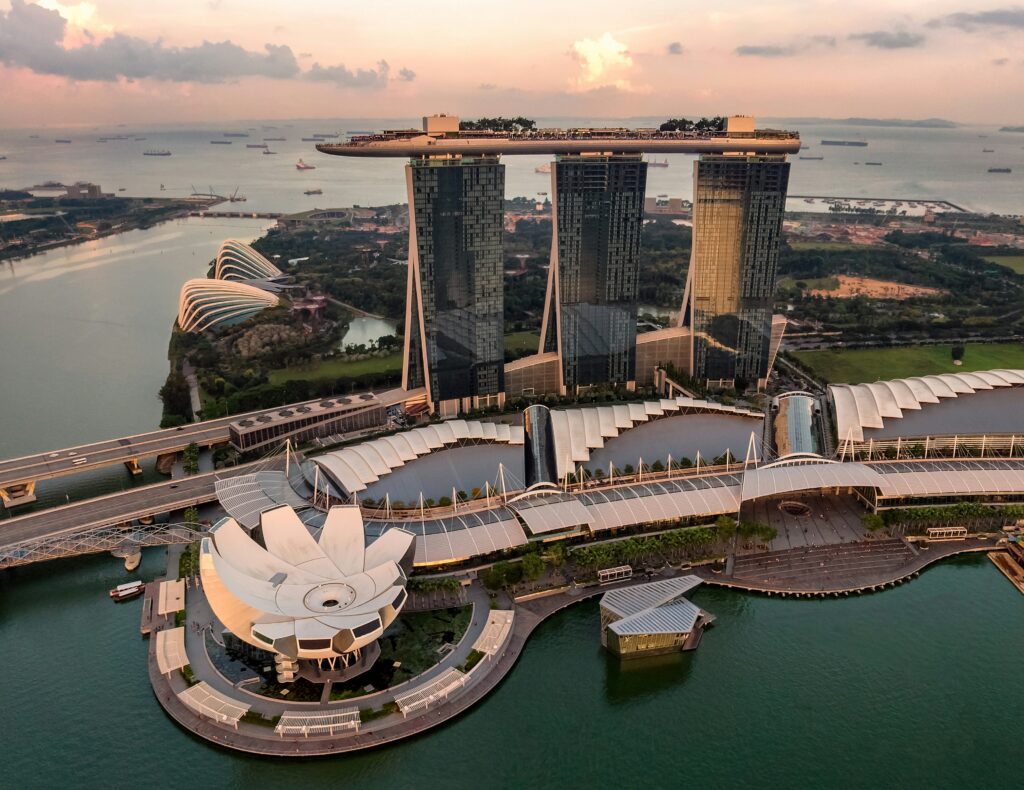
Marina Bay Sands is the most recognizable building in Singapore: three 55-story hotel towers connected at the top by a 340-meter infinity pool and observation deck. The SkyPark observation deck offers the most comprehensive view of the city available without taking a helicopter, encompassing the bay, Sentosa Island, the central business district, and on clear days the southern coast of Malaysia.
The waterfront promenade around Marina Bay connects the Merlion, the ArtScience Museum, the Esplanade performing arts center, and the financial district in a continuous walkable circuit that is best done in the evening when the city lights are reflected in the water and the temperature drops to something manageable.
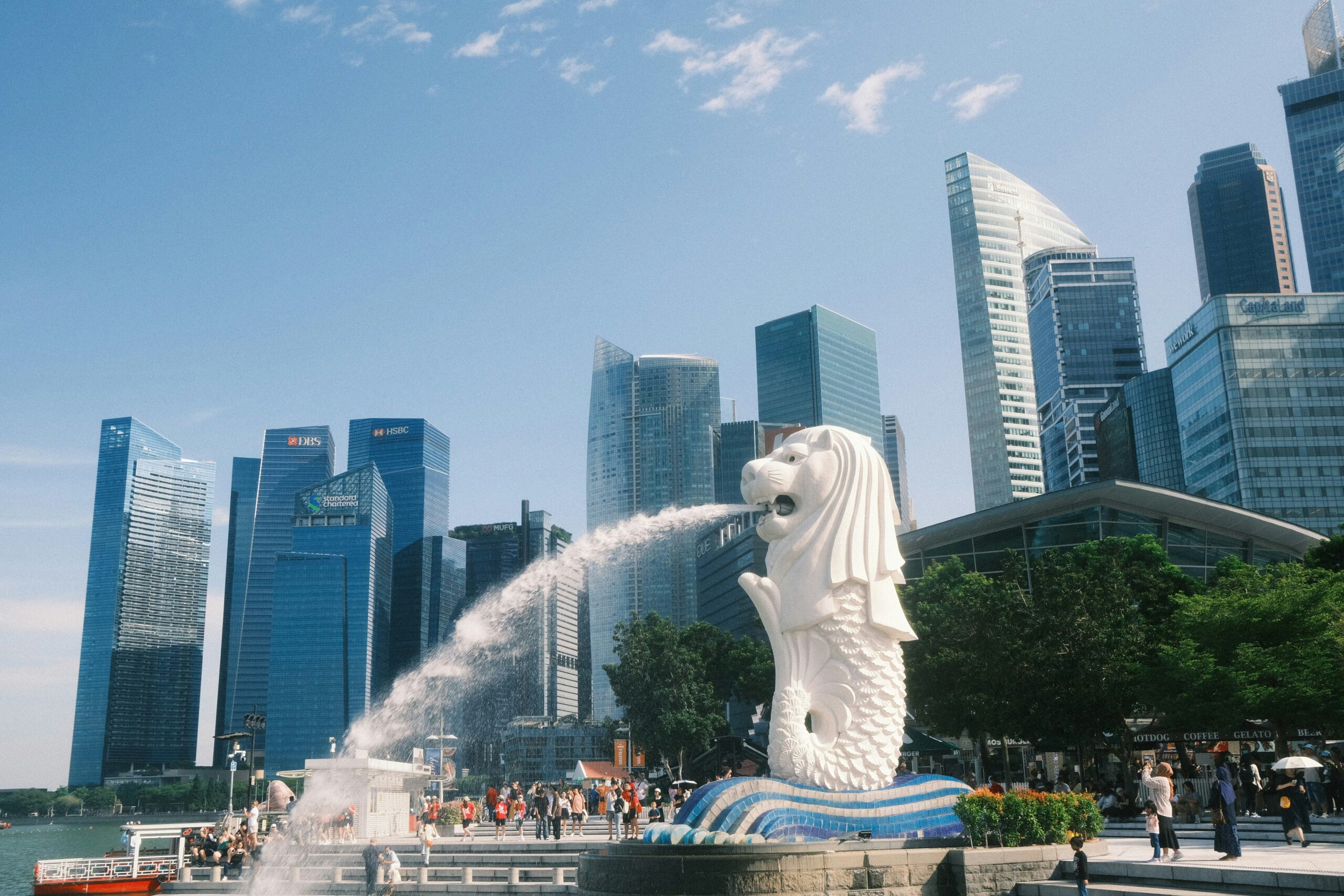
The Merlion at Marina Bay with Singapore’s financial district skyline behind. The waterfront promenade connecting these landmarks is best walked in the evening when the city lights reflect in the bay.
Sentosa Island is connected to the mainland by a cable car, monorail, and road bridge and contains the bulk of Singapore’s resort and theme park infrastructure. Universal Studios Singapore is the headline attraction. Resorts World Sentosa contains six hotels, a casino, and the S.E.A. Aquarium. The southern beaches of Siloso, Palawan, and Tanjong are Singapore’s most accessible swimming beaches, though serious beach travelers will find the water and sand underwhelming compared to neighboring Malaysia or Indonesia.
Sentosa is best treated as a half-day or full-day excursion rather than a base. The cable car from Mount Faber gives the best aerial views of the southern harbor and is worth taking for the journey alone.
The Singapore Botanic Gardens is a UNESCO World Heritage Site and one of the finest tropical gardens in the world, covering 74 hectares of manicured lawns, heritage trees, and the extraordinary National Orchid Garden containing over 1,000 species and 2,000 hybrids. Entry to the main gardens is free. The Orchid Garden charges a small admission fee.
The gardens are at their best in the early morning when the heat is manageable and the light is soft. The Swan Lake area and the Symphony Lake, where free outdoor concerts take place on Sunday evenings, are the most atmospheric sections of the garden.
Singapore’s Chinatown is one of the most authentic Chinese heritage districts in Southeast Asia, with restored shophouses, traditional medicine halls, temples, and one of the best hawker centers in the city. The Chinatown Food Street and the Maxwell Food Centre give an excellent introduction to the breadth of Singapore’s Chinese culinary tradition at very low prices. The Sri Mariamman Temple, the oldest Hindu temple in Singapore, sits at the edge of the district in one of the city’s most vivid cultural juxtapositions.
Little India around Serangoon Road is Singapore’s most sensory neighborhood. The smell of jasmine garlands and spices, the color of sari shops, the sound of Tamil music and temple bells. The Sri Veeramakaliamman Temple is extraordinarily ornate. The Sunday evening atmosphere when the area fills with South Asian workers on their day off is a genuinely moving glimpse of a different Singapore from the financial district.
Arab Street and the Kampong Glam area around the Sultan Mosque retain the atmosphere of Singapore’s Malay Muslim heritage. The blue-domed mosque is one of the city’s most beautiful buildings. The surrounding streets contain perfume shops, textile merchants, and some of the city’s most interesting independent restaurants and bars.
Tiong Bahru is Singapore’s first public housing estate, built in the 1930s in a distinctive art deco Streamline Moderne style, and has become one of the most sought-after residential and lifestyle neighborhoods in the city. The low-rise curved apartment blocks house independent bookshops, specialty coffee roasters, excellent restaurants, and a morning wet market that is one of the most genuine local experiences available in Singapore. It is the neighborhood most visitors never find and most residents are glad to keep that way.
Singapore’s food scene is the primary reason many serious travelers visit the city. The combination of Chinese, Malay, Indian, Peranakan, and colonial British culinary traditions has produced a food culture unlike any other in Asia, and the hawker center system means access to extraordinary food at prices that are genuinely affordable even by regional standards.
- Chicken rice: Singapore’s national dish. Poached or roasted chicken served over fragrant rice cooked in chicken stock with chili, ginger, and dark soy sauce. Tian Tian in Maxwell Food Centre is the most famous source
- Chili crab: Sri Lankan mud crab in a rich, spicy tomato and egg sauce. One of the great dishes of Southeast Asian cuisine. Jumbo Seafood at East Coast Park is a reliable institution
- Laksa: spicy coconut curry noodle soup with prawns, cockles, and tofu puffs. The Katong laksa style with cut noodles eaten entirely with a spoon is distinctive to Singapore
- Kaya toast: toasted bread with kaya coconut jam and butter, served with soft-boiled eggs and strong local coffee. The essential Singapore breakfast
- Rojak: a fruit and vegetable salad with a pungent prawn paste and peanut dressing. Distinctly Singaporean and available at hawker centers throughout the city
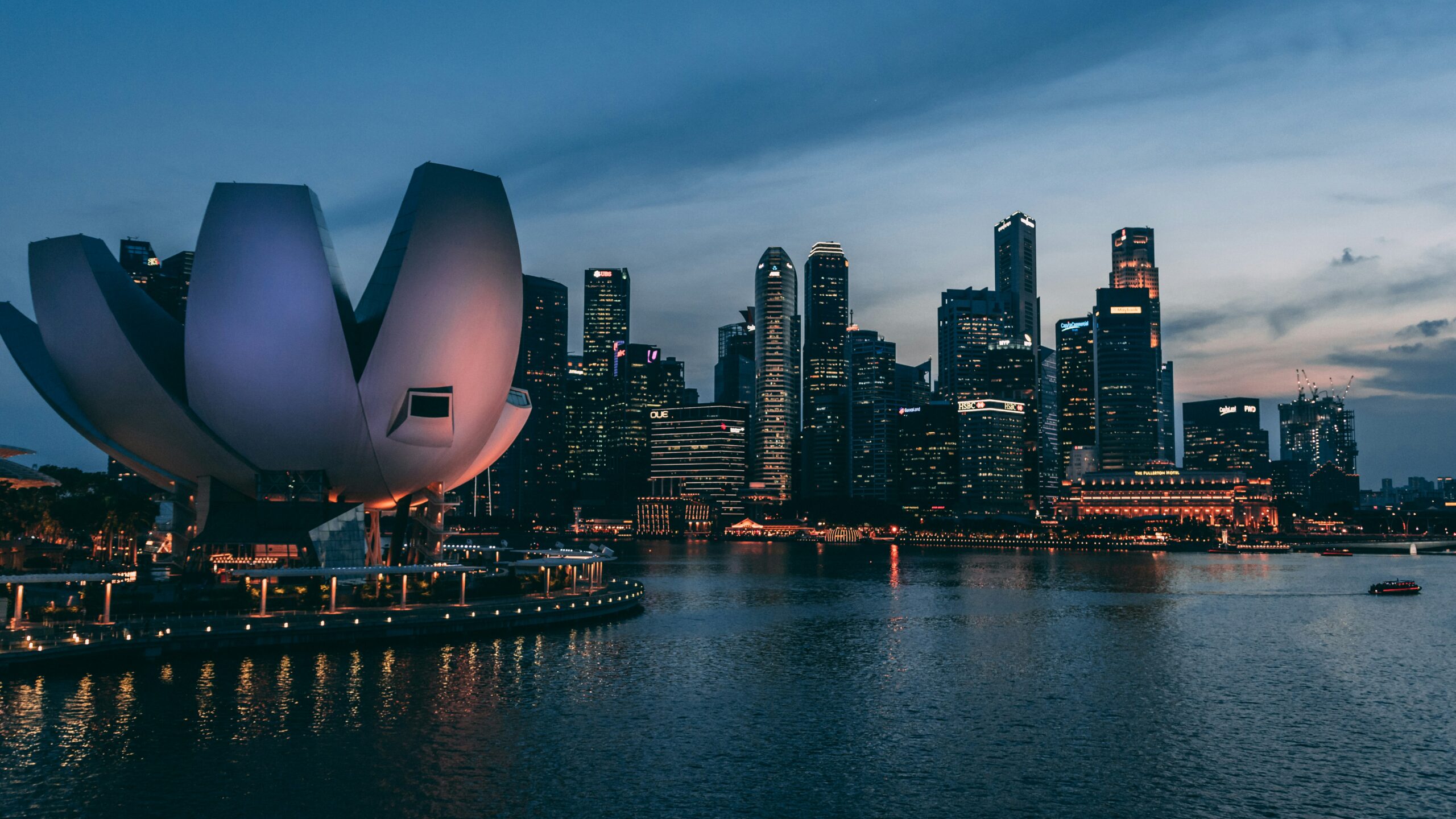
The ArtScience Museum at dusk with Singapore’s financial district skyline behind. The waterfront is at its most spectacular in the hour after sunset when the city lights begin to reflect in Marina Bay.
| Period | Weather | Events | Notes |
|---|---|---|---|
| February to April | Drier, slightly cooler | Chinese New Year (Feb) | Best weather window |
| May to July | Hot, occasional rain | Singapore Food Festival | Good overall conditions |
| August to October | Hot and humid | National Day (Aug), F1 (Sep) | Peak events season |
| November to January | Northeast monsoon | Christmas, New Year | More rain, festive atmosphere |
Singapore sits just one degree north of the equator and has no real seasons in the traditional sense. The temperature hovers between 25 and 33 degrees Celsius year-round with high humidity. The northeast monsoon from November to January brings more rain and the southwest monsoon from May to September is drier on average, but rain can occur on any day of the year.
February and March offer the most reliably dry conditions and comfortable temperatures. The Singapore Grand Prix in September transforms the city center into a street circuit and brings a electric energy to the Marina Bay area. Chinese New Year in January or February is the most atmospheric time to explore Chinatown.
- MRT (Mass Rapid Transit): Singapore’s subway system is one of the finest in the world: clean, punctual, air-conditioned, and covers virtually every attraction in the city. Get an EZ-Link card at any station for contactless payment across all public transport
- Bus: the bus network covers areas the MRT does not reach, particularly in residential neighborhoods. The same EZ-Link card works across buses and MRT
- Grab: Singapore’s dominant ride-hailing app. Reliable, well-priced, and available throughout the city. Taxis are also widely available and metered
- Walking: the central areas of Singapore including Marina Bay, Chinatown, and the colonial district are very walkable. The underground linkways connecting shopping malls provide air-conditioned pedestrian routes through much of the city center
- Singapore is expensive: accommodation, alcohol, and taxis cost significantly more than in neighboring Southeast Asian cities. Food at hawker centers is the major exception and represents extraordinary value
- Laws are strictly enforced: chewing gum is banned from import and sale. Littering, jaywalking, and smoking in non-designated areas carry fines. These rules are not jokes and apply equally to visitors
- Changi Airport is worth arriving early for: the airport has a waterfall, a movie theater, gardens, and excellent food throughout. The Jewel complex connecting the terminals is extraordinary architecture and worth time in itself
- Tap water is safe to drink: Singapore’s water quality is among the highest in Asia. Bottled water is an unnecessary expense
- Air conditioning is everywhere: Singapore’s malls, MRT stations, and most restaurants are intensely air-conditioned. A light layer is useful for extended time indoors
Singapore consistently surprises travelers who arrive expecting a sterile, rule-bound city and leave having eaten some of the best food of their lives, walked through neighborhoods of extraordinary cultural layering, and stood in front of architecture that simply does not exist anywhere else.
This Singapore travel guide gives you the foundation. The hawker centers, the heritage neighborhoods, and the extraordinary efficiency of a city that has built itself from almost nothing into one of the most remarkable urban environments on earth will take care of the rest.
Ready to Plan Your Singapore Trip?
Discover more Asia guides, destination tips, and travel itineraries on Tripfavor.
Explore Tripfavor →