
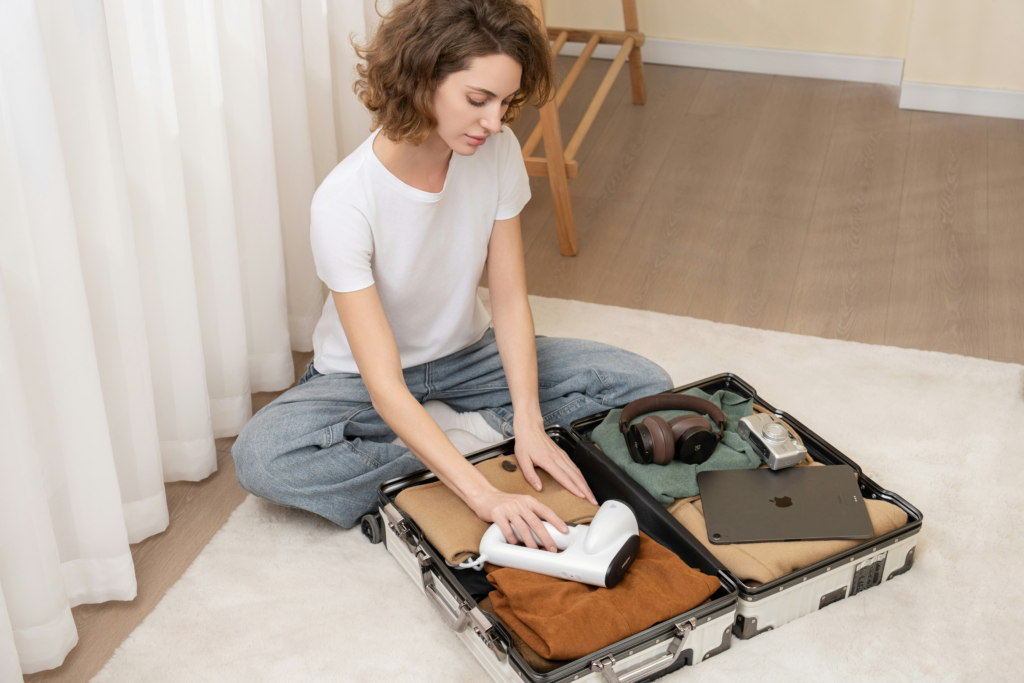
Learning how to pack a carry-on only changed the way I travel. No baggage fees, no waiting at carousels, no standing at the belt hoping your bag made the connection. This guide covers what actually works, by trip type and climate, tested across 40+ countries.
Airlines have quietly pushed checked bag fees to uncomfortable levels. A round trip on a major carrier now costs $70 to $150 extra just to bring clothes. Add a connection through a busy hub and you’re looking at a real chance of arriving without your luggage. Anyone who’s had a bag lost on a tight connection in Istanbul or Casablanca knows the math: one bag, one cabin, full control.
The question is not whether traveling hand luggage only is possible. It is how to do it without feeling like you’re rationing your own wardrobe.
Quick Answer: Packing a Carry-On Only

A good packing system takes one trip to build. After that, it becomes automatic.
What Does Checking a Bag Actually Cost You?
Before the how, it helps to understand what you’re actually saving. Most people think about the money, which is real enough. But the time calculation is what usually seals the decision.
Major carriers charge $35 to $75 per checked bag each way. On a round trip with one connection, that’s $140 to $300 gone before you’ve boarded. Budget airlines can charge more if you book the bag at the airport rather than online.
Skipping check-in lines and the arrival carousel recovers 45 minutes to 1.5 hours per direction. On a week-long trip, that’s a full afternoon of your life back. On a short city break, it’s the difference between catching a train and missing one.
Your bag travels with you. Theft from checked luggage is more common than airlines admit, and claims processes are slow. Medications, electronics, and documents stay in the cabin where you can see them.
You can book last-minute flights on carriers that charge heavily for hold luggage. You can take overnight buses, switch hotels on short notice, and walk out of any airport without waiting for anyone or anything.
Which Bag Should You Choose?
This is where most people get it wrong the first time. They buy a bag that is technically the right size but wrong for how they actually travel. There are two formats worth considering.
Works well for business travel, city trips, and anyone who moves between hotels every two or three days. Easy to wheel through airports. A poor choice for anywhere with cobblestones, train stations with stairs, or travel that mixes hotels with smaller guesthouses. The wheels become a liability the moment you leave smooth floors.
European city breaks Business tripsThe better choice for multi-country routes, budget airlines with strict overhead rules, and any destination where terrain varies. Soft-sided bags compress into bins where a hard shell would not fit. The Osprey Farpoint 40 is a common choice; any structured 40L pack with a laptop sleeve and hip belt works. The hip belt matters more than people expect on longer walking days.
Multi-destination routes Budget airlines Mixed terrain| Bag type | Best for | Strength | Weakness |
|---|---|---|---|
| Hard-shell spinner (~40L) | Business travel, city trips, hotel-to-hotel | Easy to wheel through airports | Struggles on cobblestones, stairs, mixed terrain |
| Travel backpack (40-45L) | Multi-country routes, budget airlines, mixed terrain | Compresses into tight overhead bins, hands-free carrying | Less convenient to wheel on smooth, flat airport floors |
Building a Wardrobe That Actually Fits
The 5-4-3-2-1 framework is a starting point used by experienced one-bag travelers. It is not a rigid rule, but it gives you something to edit down from rather than building up from zero.
- 5 tops, mixing short and long sleeve, in neutral colors that can share bottoms
- 4 pairs of underwear in Merino wool or quick-dry synthetic fabric
- 3 bottoms: one pair of trousers, one shorts or skirt, one versatile third piece
- 2 pairs of shoes: one for walking all day, one that works for an evening out
- 1 outer layer: a packable down jacket or rain shell depending on the climate
This covers 7 days without laundry and up to 10 or 12 days if you wash items in a sink. For longer trips, plan one laundry session per week and the framework scales without adding volume.

Neutral colors let pieces share context across different days and settings.
Fabric Matters More Than Quantity
Two shirts made from the wrong material take up the same space as four made from the right one, and they smell after a single afternoon in summer heat. What your clothes are made of determines how many you actually need to bring.
Odor-resistant, temperature-regulating, quick-drying, and wrinkle-resistant. A Merino t-shirt worn three days straight does not smell the way a cotton one would after one. Icebreaker, Uniqlo Merino, and Wool&Prince are reliable options at different price points. The upfront cost is higher, but one Merino shirt replaces two or three cotton ones in practice.
Polyester and nylon blends dry fast, pack small, and cost less than Merino. They work well for active days, hiking, and hot destinations. The trade-off is odor after multiple wears: synthetic fabric holds smell more than wool. Good for physical days; less suited for wearing repeatedly without washing.
Cotton takes a long time to dry and wrinkles on contact. Jeans are the hardest item to justify in a carry-on: heavy, stiff, slow to dry, and they fill a third of the bag on their own. Linen wrinkles worse than cotton and usually requires an iron. Silk needs careful handling and dislikes machine washing. None of these are worth the space relative to what you get back.
Pack by Category, Not by Day
Most people mentally pack by running through each day of the trip: “Monday I need this, Tuesday that.” The problem is that this approach produces worst-case thinking for every day independently, which adds up fast. Packing by category is more accurate and cuts the list down.
Liquids go in a 1-liter clear bag per TSA and EU rules, containers under 100ml each. Solid bars for shampoo, conditioner, and soap remove the liquid restriction entirely and are now available at most pharmacies. Only carry what is prescription or genuinely hard to find at your destination.
One universal power adapter, one cable per device, a small USB charging hub to reduce the number of wall plugs you need. A portable battery pack is worth carrying. If your phone camera is less than three years old, the dedicated camera probably stays home.
Passport, one backup payment card stored separately from your main wallet, insurance documents, and any printed reservations you might need without mobile data. Keep this pouch near the top of your bag, not buried under clothing.
Not required, but they solve the problem of repacking every morning. One cube per category means you pull the right one rather than unpacking everything. Compression cubes reduce volume on bulkier items by 20 to 30%, which matters on cold-weather trips with layers.
The Final Check Before You Zip
Once everything is packed, run through this final check in order before you zip the bag closed:
- Put the bag on and walk around for ten minutes. If it pulls at your shoulders or feels unmanageable, something has to come out.
- Would I pay 30 dollars to have this delivered to my destination if I forgot it?
- Have I actually used this item in the last 30 days?
- Can I buy this cheaply at the destination if I need it?
- Am I packing this because I will use it, or because I might want it?
- Is this the item that comes on every trip and never leaves the bag?
Anything that fails the 30-day use test or only exists for vague “just in case” scenarios gets left behind. Most things you can buy abroad, often cheaper than at home.
Carry-On Packing by Trip Type
Warm-weather packing is actually the easiest format. Light clothing compresses to almost nothing. Four tops, two bottoms, one swimsuit, one pair of sandals for walking, one pair of flip flops, and one outfit that works for an evening out. Sunscreen is available everywhere and usually cheaper locally. A sarong doubles as a towel, beach mat, and coverup.
Morocco coast Mediterranean Southeast AsiaThis is the format that converts most people permanently. Fly carry-on from Casablanca or Marrakech to Paris or Barcelona, walk off the plane, and go straight to the metro while everyone else watches a belt. If you land before check-in opens, a left-luggage option through Radical Storage means you’re not stuck dragging a bag around a city for hours. Neutral clothes that transition from a museum to dinner with a jacket swap cover the full range of city situations.
Paris Barcelona RomeThe hardest carry-on scenario, but still manageable. The system is layering, not volume. A Merino base layer, a fleece mid-layer, and a packable down jacket together cover temperatures from 5C down to around -15C. Wear the heaviest pieces on the plane. Thermal underwear adds almost nothing to bag volume but extends the warmth range of every outfit significantly.
Scandinavia Northern Europe winter High altitudeThe wrinkle problem is the main objection. Merino wool dress shirts exist and hold up better than expected. Suit jackets travel inside a dry-cleaning bag to prevent creasing. Technical dress trousers marketed as “travel trousers” resist wrinkles far better than traditional wool or cotton suiting fabric. Some travelers ship one garment bag ahead to the hotel for longer trips.
Conferences Client meetingsWhat People Who Actually Pack Light Do Differently
A few habits show up consistently among travelers who genuinely manage one bag across long trips, not people who pack light in theory and check a bag at the airport:
- They plan laundry into every trip longer than five days. A sink and a bar of travel soap handles most situations.
- They own fewer travel-specific pieces than you would expect. Three or four versatile items that work across different settings beat a larger wardrobe of specialized ones.
- They buy things at the destination: sunscreen, shampoo, a cheap t-shirt when it is hot. Pharmacies and markets exist everywhere.
- They leave space in the bag on purpose, to bring things back or pick up items they need locally without repacking the whole thing.
- They wear the same shoes for most of the trip. One pair that handles walking and also looks reasonable over dinner covers nearly every situation.
For building destination-specific packing lists, PackPoint generates weather-appropriate suggestions based on your dates and activities. It will not replace judgment, but it is a useful cross-check when packing for a climate you have not traveled to before.
FAQ: How to Pack a Carry-On Only
Final Thoughts
Packing carry-on only is not about traveling with less. It is about traveling with exactly what you need, nothing that has to be managed, waited for, or worried about. The first trip you do this way, you will likely bring a few things you do not touch. That is normal. The list gets shorter with each trip, not because you pack less confidently, but because you know your actual habits.
Most people who try it on a short trip never go back to checking bags for anything under two weeks. The decision usually happens at arrivals, standing outside the terminal while everyone else is still waiting at the belt.
A 4-day city break from Morocco to Europe is the ideal first test. Short enough that the consequences of forgetting something are minor, long enough to know whether your system holds up.
Planning Your Next Trip?
Browse our destination guides for region-specific packing advice, including detailed Morocco travel resources to help you plan from home.
Explore Destinations
Pingback: International Travel Checklist for Beginners: Complete Guide