
Paris Travel Guide: Everything You Need to Know
Paris is the most visited city on earth, and it has held that position for good reason. The food, the architecture, the museums, the culture, the sheer density of extraordinary things to see and do within a walkable city center: Paris delivers on almost every expectation and then finds ways to exceed them in the quiet moments between the famous ones. A conversation at a zinc bar. A market on a Sunday morning. The light on the Seine at dusk.
This Paris travel guide covers everything first-time visitors need to know: the essential landmarks and museums, the best neighborhoods to explore, where to eat and drink, how to get around, the best time to visit, and the practical details that make one of the world’s most complex and rewarding cities feel navigable rather than overwhelming.
Paris has been drawing travelers for centuries and the reasons have not fundamentally changed. The city is extraordinarily beautiful in ways that feel both designed and accidental. Haussmann’s grand boulevards frame views of monuments with an intentionality that rewards walking in a way few other cities manage. The cultural infrastructure, concentrated in a relatively small area around the Seine, represents the greatest density of world-class museums and cultural institutions in the world.
According to the Paris Convention and Visitors Bureau, Paris welcomes over 30 million international visitors annually. The city’s position as a global hub for fashion, gastronomy, art, and architecture gives it a relevance that cities with only historical significance cannot match.
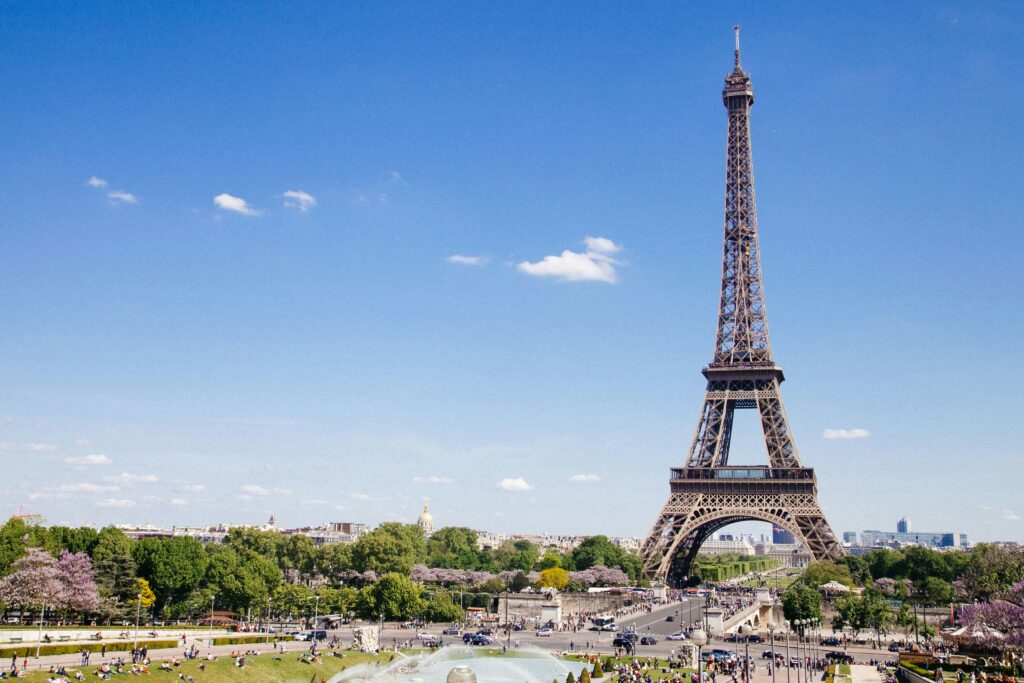
The Eiffel Tower is the most visited paid monument in the world and one of those rare tourist attractions that genuinely lives up to its reputation. Built for the 1889 World’s Fair and intended to be dismantled after 20 years, it has stood for over 130 years and remains the defining image of Paris from every angle.
The tower is most spectacular from a distance, particularly from the Trocadero gardens across the Seine or from the Champ de Mars lawn below. The view from the summit on a clear day extends 70 kilometers in every direction across the Paris basin. Book tickets online well in advance, particularly for summer visits when queues for walk-up entry can exceed three hours.
- Summit tickets: approximately 29 euros per adult
- Best time: late afternoon for the golden hour light, or after dark when the tower sparkles on the hour
- Book: weeks in advance for peak season dates at ticket.toureiffel.paris
The Louvre is the largest art museum in the world and contains one of the most extraordinary collections of human creative achievement ever assembled in a single building. The Mona Lisa, the Venus de Milo, the Winged Victory of Samothrace. These are not just famous works but genuinely extraordinary objects that reward the experience of standing in front of them regardless of how many images you have seen beforehand.
Plan your Louvre visit carefully. The museum is enormous and trying to see everything in a single day is both physically impossible and aesthetically counterproductive. Choose two or three wings and explore them thoroughly. The Richelieu wing containing the French and Northern European collections is consistently less crowded than the Denon wing where the Mona Lisa is displayed.
The Musee d’Orsay houses the world’s greatest collection of Impressionist and Post-Impressionist art in a converted Beaux-Arts railway station on the left bank of the Seine. Monet, Renoir, Degas, Van Gogh, Cezanne, Gauguin. The collection is extraordinary and the building itself is as magnificent as anything it contains.
The d’Orsay is more manageable in scale than the Louvre and can be covered properly in three to four hours. The top floor with the Impressionist masterworks is the most visited section. The middle floor sculptures and the restaurant behind the giant clock face on the Seine side are among the less-visited highlights of the museum.
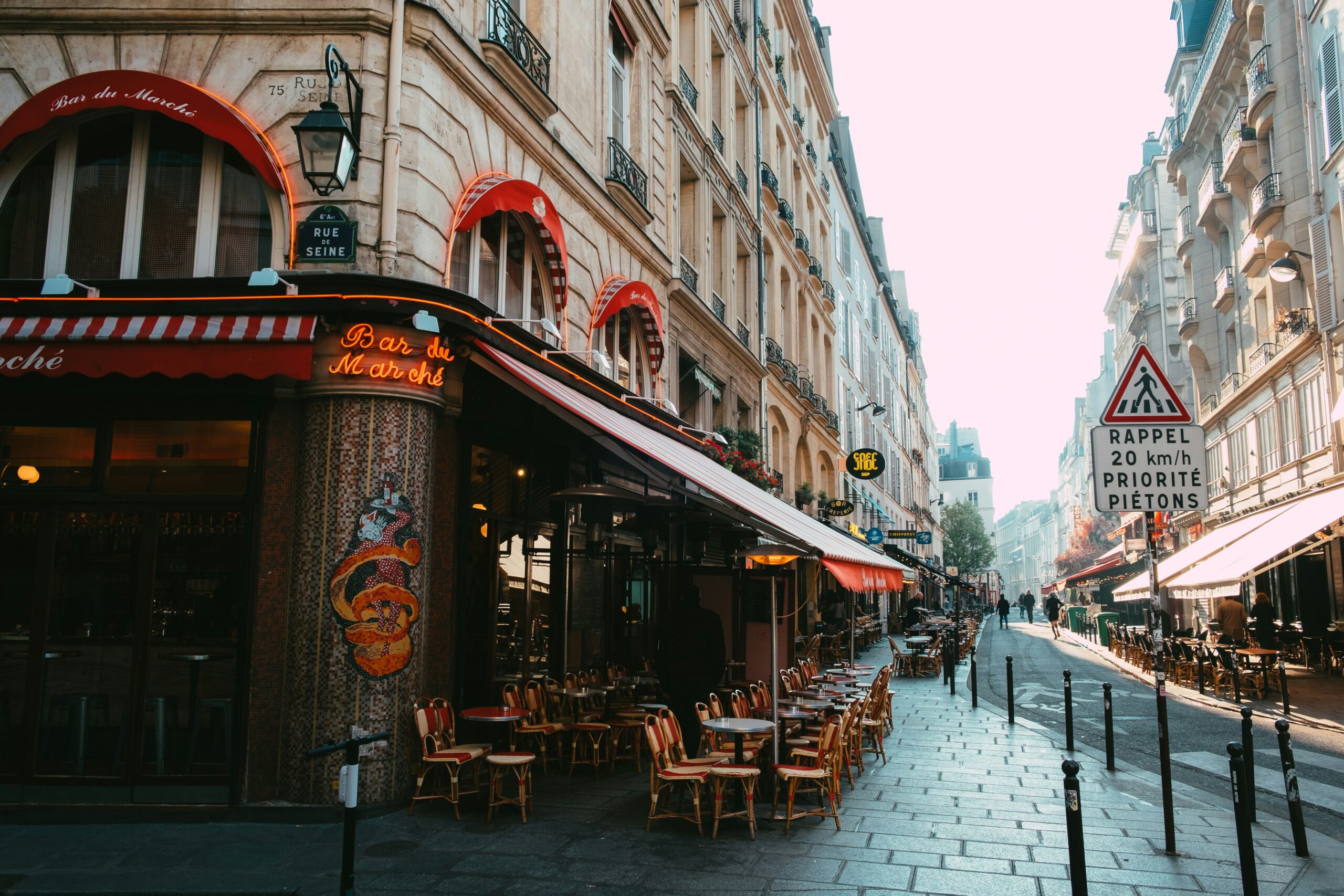
Rue de Seine in Saint-Germain-des-Pres at dawn. The Left Bank cafe culture is one of Paris’s most enduring pleasures, best experienced before the morning crowds arrive.
Notre-Dame Cathedral on the Ile de la Cite is one of the finest examples of French Gothic architecture in existence and one of the most visited monuments in Europe. The cathedral was severely damaged by fire in April 2019 and reopened in December 2024 following an extraordinary restoration effort. The rebuilt interior is now accessible to visitors and the restored structure represents both a preservation achievement and a demonstration of extraordinary craft.
The area around Notre-Dame, including the archaeological crypt beneath the square, the Sainte-Chapelle with its extraordinary stained glass just around the corner, and the quiet streets of the Ile Saint-Louis immediately adjacent, deserves a full half-day of exploration.
Montmartre sits on the highest hill in Paris and was the artistic heart of the city in the late 19th and early 20th centuries, home to Picasso, Modigliani, Toulouse-Lautrec, and dozens of artists who defined the era. The neighborhood retains a distinctly village character that feels different from the grand Haussmannian boulevards below.
The Sacre-Coeur Basilica at the summit offers one of the best free panoramic views in Paris. The streets immediately below the basilica around Place du Tertre are heavily tourist-facing, but walking 10 minutes in any direction into the quieter residential streets reveals a Paris that most visitors never find.
Le Marais on the Right Bank is one of the few Paris neighborhoods that escaped Haussmann’s 19th-century redevelopment, preserving its medieval street pattern and an extraordinary concentration of Renaissance hotels particuliers (private mansions). Today the district contains excellent museums including the Musee Picasso and the Musee Carnavalet, the Place des Vosges (the oldest planned square in Paris), the Jewish Quarter around Rue des Rosiers, and one of the most vibrant LGBTQ+ communities in Europe.
Saint-Germain-des-Pres on the Left Bank is the neighborhood most associated with Parisian intellectual and literary culture. The cafes where Sartre and de Beauvoir wrote, the bookshops where James Joyce and Ernest Hemingway browsed, the gallery-lined streets that still represent the serious end of the Paris art market. The neighborhood is expensive but not exclusively so, and walking its streets gives the most concentrated sense of what Paris has historically meant to European intellectual life.
The Canal Saint-Martin area in the 10th arrondissement is where contemporary Parisian life is most visible. The tree-lined canal is lined with independent cafes, concept stores, and restaurants that represent the city’s current food and culture scene rather than its historic one. Sunday afternoons when the canal towpaths fill with Parisians picnicking and cycling give a genuinely local view of the city that the tourist districts cannot replicate.
Eating well in Paris is one of life’s great pleasures and more accessible than its reputation for formality suggests. The city has elevated casual dining to an art form in recent years and the range of excellent food available at every price point is genuinely extraordinary.
- Croissant: the benchmark of any Paris boulangerie visit. The best croissants are laminated with extraordinary care and shatter when broken. Du Pain et des Idees and Stohrer are among the most celebrated boulangeries in the city
- Steak frites: the quintessential Parisian bistro dish. A properly cooked entrecote with hand-cut fries and bearnaise sauce is one of the great simple pleasures of French cuisine
- Soupe a l’oignon: French onion soup with a gruyere crouton, best eaten in a traditional brasserie on a cold Paris evening
- Croque monsieur: a grilled ham and cheese sandwich elevated to an art form. Available at virtually every cafe and bistro in the city
- Tarte tatin: upside-down caramelized apple tart served warm with creme fraiche. One of France’s greatest contributions to world dessert culture
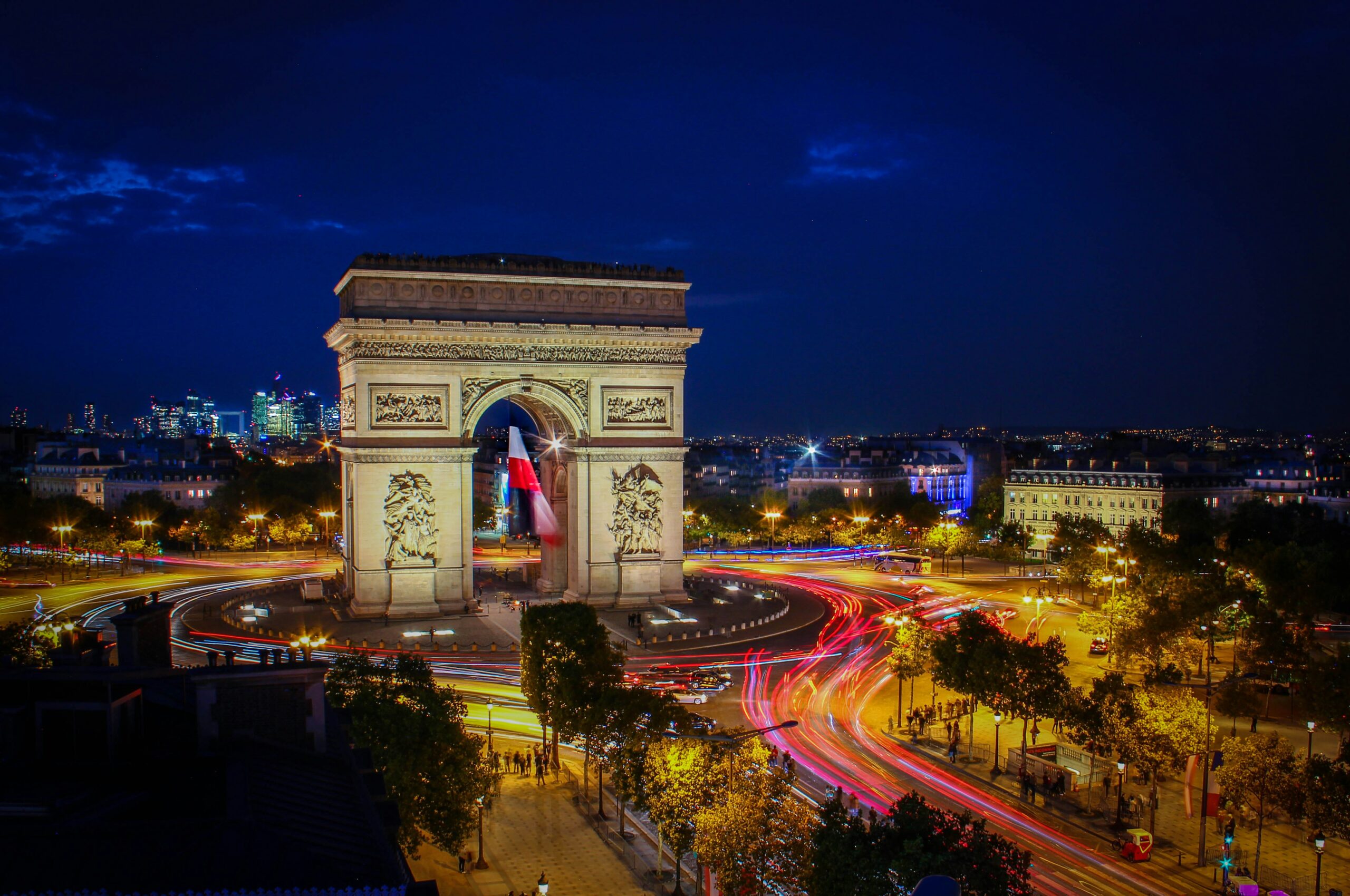
The Arc de Triomphe at night with the light trails of traffic on the Champs-Elysees. The view from the top of the arch over the twelve radiating avenues is one of the best free panoramas in Paris.
| Period | Weather | Crowds | Notes |
|---|---|---|---|
| April to June | Mild, occasional rain | High | Best overall conditions |
| July to August | Warm to hot | Very high | Peak season, many locals leave |
| September to October | Mild and clear | Moderate | Excellent conditions, fashion week |
| November to March | Cold, grey | Low | Lowest prices, atmospheric |
April to June and September to October are the best times to visit Paris. Spring brings the city back to life after winter with blossom in the parks, cafe terraces reopening, and the particular quality of Parisian light in April that painters have been trying to capture for centuries. Autumn is equally beautiful with golden light on the Seine and manageable crowds.
July and August are peak tourist season but also the months when Parisians themselves leave the city for their own holidays. The city is simultaneously at its most crowded with tourists and its most empty of locals, creating an experience that is simultaneously busy and oddly quiet in the residential neighborhoods. Hotel prices are at their highest in these months.
- Metro: Paris’s subway system is fast, frequent, and covers the entire city comprehensively. The 16-line network connects every major attraction and neighborhood. A carnet of 10 tickets offers better value than single tickets
- Walking: the best way to experience central Paris. The distance between major landmarks is consistently shorter than it appears on maps and the journey between them is always interesting
- Velib bikes: Paris’s bike-share system covers the city with stations every few hundred meters. Excellent for riverside cycling along the Seine and exploring neighborhoods at a comfortable pace
- RER: the rapid transit network connecting central Paris to the airports and to Versailles. Essential for day trips outside the city
- Taxis and Uber: readily available throughout the city. Uber tends to be faster to book during peak hours
- Learn basic French phrases: Bonjour, merci, s’il vous plait. Greeting shopkeepers and waiters in French before switching to English is both polite and almost universally appreciated
- Book major museums in advance: the Louvre, Musee d’Orsay, and Versailles all require timed entry tickets booked online. Walk-up queues can take 2 to 3 hours in peak season
- Validate your metro ticket: always stamp your ticket in the machine before boarding. Inspectors board trains regularly and fines for unvalidated tickets are immediate
- Carry some cash: many smaller bistros, street markets, and boulangeries prefer cash. ATMs are widely available throughout the city
- Avoid tourist menus near major attractions: restaurants directly adjacent to the Eiffel Tower and Notre-Dame are typically poor value. Walk two streets in any direction for dramatically better food at lower prices
Paris rewards the traveler who slows down. The famous landmarks are extraordinary and worth every queue. But the city reveals itself most completely in the hours between the scheduled visits: the morning coffee at a zinc bar, the afternoon in a park watching Parisians play petanque, the long dinner that begins at 8pm and is still going at midnight.
This Paris travel guide gives you the structure. The city will provide everything else, and it has been doing that for longer than almost anywhere else on earth.
Ready to Plan Your Paris Trip?
Discover more Europe guides, destination tips, and travel itineraries on Tripfavor.
Explore Tripfavor →