
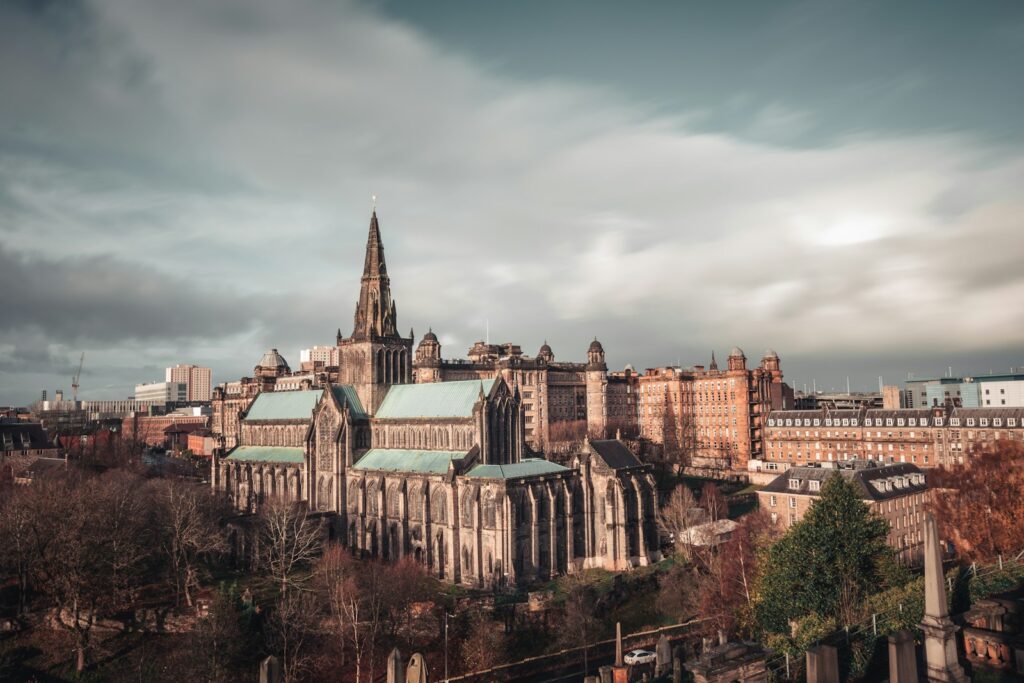
Glasgow landed on Tripadvisor’s 2026 list of trending European cities, alongside Madeira, Tbilisi and Milan. It rewards visitors who skip the postcard version of Scotland: free world-class museums, a medieval cathedral beside a Victorian hilltop cemetery, and a pub-lined cobbled lane. Here is what to see and how to organise it.
Quick Answer
- Must-see: Kelvingrove Art Gallery and Museum, free to enter, with a Spitfire hanging in the West Court
- Best historic pairing: Glasgow Cathedral and the Necropolis, side by side on the hill
- Getting around: the Subway, a 15-station loop opened in 1896, with a flat fare and contactless payment from early 2026
- Minimum trip length: 2 days for the highlights; 3 days adds the West End and the river
- Pack: a waterproof layer, because Glasgow weather changes quickly
What Are the Best Things to Do in Glasgow?
- Kelvingrove Art Gallery and Museum: entry is free, with Salvador Dalí’s Christ of St John of the Cross on the ground floor, a Spitfire in the West Court and free daily organ recitals on the 1901 Lewis and Co organ. Some areas are scaffolded during restoration, but the museum stays open.
- Glasgow Cathedral: according to tradition, St Mungo (Kentigern) built his church beside the Molendinar Burn, where the cathedral now stands. The University of Glasgow was founded next to it in 1451.
- The Necropolis: a Victorian cemetery on the hill behind the cathedral, known for sweeping views over the city.
- The Burrell Collection: one of Glasgow’s internationally known cultural institutions, which opened in 1983 and is known for its medieval tapestries.
- Ashton Lane: a cobbled lane near the university packed with bars, restaurants and a small cinema, liveliest in the evening.
- The River Clyde and Riverside Museum: walk, cycle or take a boat on the river, or view it from the Riverside Museum.

The medieval spire of Glasgow Cathedral rising above the trees
How Do Glasgow’s Main Attractions Compare?
| Attraction | Type | Best for | Plan on |
|---|---|---|---|
| Kelvingrove | Art and natural history museum | Rainy days, families, art lovers | 2 to 3 hours; free entry |
| Glasgow Cathedral | Medieval church | History and architecture | 1 hour |
| The Necropolis | Victorian cemetery | City views and photography | 1 hour, paired with the cathedral |
| Burrell Collection | Art collection | Medieval art and tapestries | 2 hours |
| Ashton Lane | Bars and restaurants | Evening out | An evening |
How Do You Get Around Glasgow?
The Glasgow Subway opened on 14 December 1896 and runs in a circle of almost 6.5 miles (10.5 km) with 15 stations. It uses a flat fare, so one ticket allows unlimited travel for as long as you stay on, and contactless payment was introduced across all stations in early 2026, according to Wikipedia. Locals simply call it “the Subway.”
The city centre and West End are walkable, and Glasgow Airport is the city’s main airport. Arrange a transfer in advance if you land late.
What Is a Simple 3-Day Glasgow Itinerary?
| Day | Focus |
|---|---|
| Day 1 | Glasgow Cathedral and the Necropolis in the morning, city centre in the afternoon, dinner on Ashton Lane |
| Day 2 | Kelvingrove Art Gallery and Museum, then a stroll through the West End and the Botanic Gardens glasshouses |
| Day 3 | The Burrell Collection, then the River Clyde and Riverside Museum |
Book Your Glasgow Trip
Reserve attraction tickets and sort your arrival before you go.
What Should You Know Before You Visit?
- Check opening hours. Kelvingrove currently opens 10am to 5pm Monday to Thursday and Saturday, and 11am to 5pm on Friday and Sunday, but confirm on the museum’s site before you go.
- Special exhibitions can be ticketed. General entry is free, but some temporary shows charge separately.
- Bring rain gear. Pair outdoor sights with indoor ones so a shower never ruins the day.
- Donations help. Kelvingrove welcomes donations at the venue or online.
Planning More of Europe?
Frequently Asked Questions
Is Kelvingrove free to visit?
Yes. Entry to Kelvingrove Art Gallery and Museum is free, though some special exhibitions are ticketed and donations are welcome.
How many days do you need in Glasgow?
Two days covers the main sights; three days adds the West End, the Burrell Collection and the River Clyde at a relaxed pace.
How does the Glasgow Subway work?
It is a 15-station loop with a flat fare, so one ticket gives unlimited travel for as long as you stay on. Contactless payment was introduced in early 2026.
What is the Necropolis in Glasgow?
It is a Victorian cemetery on a hill behind Glasgow Cathedral, popular for its views over the city.
Final Thoughts
Glasgow works best when you let the free museums and the pubs do the heavy lifting. Pair the cathedral with the Necropolis, give Kelvingrove a proper half-day, and keep your evenings for Ashton Lane.
Keep Exploring
More destination guides, packing lists, and itinerary breakdowns to help plan your next trip.