
Kyoto was Japan’s imperial capital for over a thousand years, and the weight of that history is present on every street. With more UNESCO World Heritage Sites than any other city in Japan, over 1,600 Buddhist temples, 400 Shinto shrines, and a living culture of tea ceremony and traditional craft, Kyoto is unlike anywhere else in the country. This complete Kyoto travel guide covers everything first-time visitors need to know.
Tokyo is extraordinary and Osaka is alive in a way few cities can match. But Kyoto operates at a different frequency entirely. The city was spared from bombing during the Second World War, which means its historic districts, wooden machiya townhouses, and temple gardens are not reconstructions, they are the actual structures that generations of Japanese emperors, monks, and artisans built over centuries.
Planning the wider Japan trip? Our 2-week Japan itinerary covers how to structure Tokyo, Kyoto, and beyond, and our guide to the best time to visit Japan covers cherry blossom and autumn foliage timing in detail. If this is your first trip to the country, our first time in Japan guide covers the basics before you arrive.
Kyoto: Quick Travel Facts

Kyoto’s autumn foliage peaks in mid to late November and rivals cherry blossom season in visual intensity. The temple gardens of Tofuku-ji and Eikan-do are among the most spectacular displays.
Top Things to Do in Kyoto
Fushimi Inari is the most visited shrine in Kyoto and one of the most photographed sites in Japan. The shrine is famous for its thousands of vermilion torii gates that line the trails climbing the wooded slopes of Mount Inari. The gates were donated by businesses and individuals over centuries, each bearing the donor’s name and date in black ink on the back.
The full trail to the summit takes approximately 2 to 3 hours return. The most photographed section, where the gates are densest and closest together, is in the first 20 minutes of the climb. The upper trails beyond the main tourist flow offer extraordinary forest scenery and almost complete solitude even in peak season.
Kinkaku-ji, the Temple of the Golden Pavilion, is covered in gold leaf and reflected in the still pond in front of it. The image is one of the most recognizable in Japanese travel photography and the reality genuinely lives up to it, particularly in early morning winter when the pavilion sits above a thin layer of snow and the reflection in the water is perfect.
The site is crowded throughout the day but the viewing path moves efficiently. Allow 45 to 60 minutes for the full garden walk. Combine with Ryoan-ji, the famous rock garden temple 10 minutes away on foot, it is far less visited despite its equal cultural significance and the dry garden is one of the most quietly powerful spaces in Kyoto.
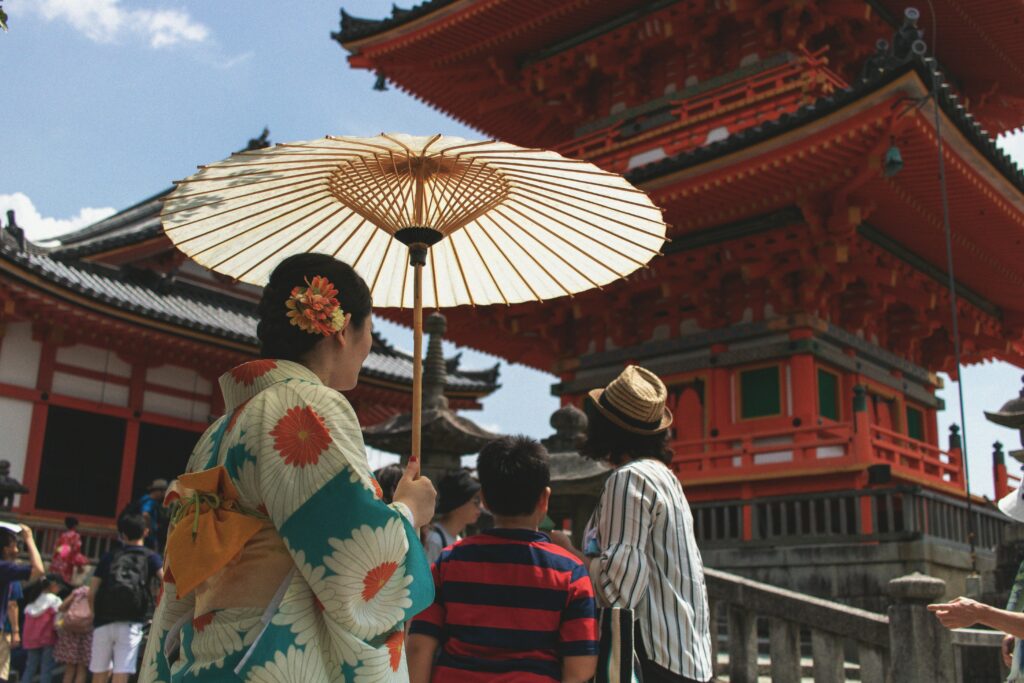
Kiyomizu-dera is a wooden temple complex built into the hillside above Higashiyama, with a famous stage extending 13 meters over the valley below supported by 139 pillars joined without a single nail. The view from the stage encompasses the Kyoto valley, the surrounding forested hills, and on clear days the distant mountains of the Higashiyama range.
The approach through the Sannen-zaka and Ninen-zaka stone-paved lanes is as much a part of the experience as the temple itself. These preserved merchant streets are lined with tea houses, ceramics shops, and vendors selling Kyoto specialties. The entire area turns extraordinary colors in autumn foliage season, making it one of the most photographed spots in Japan during November.
The Arashiyama Bamboo Grove is one of Japan’s most iconic natural sights. The tall bamboo stalks create a tunnel of green filtered light and the sound of wind through the grove is extraordinary enough to be listed as one of Japan’s 100 Soundscapes to Protect. The grove runs for several hundred meters between Tenryu-ji temple and the Okochi Sanso villa garden.
Arashiyama as a district extends well beyond the bamboo grove and rewards a full day. Tenryu-ji garden is one of the finest in Kyoto. Traditional wooden boats offer river rides along the Hozu River gorge. The hillside above the district contains quieter temple trails with panoramic views across the Kyoto basin. The Saga-Toriimoto Preserved Street, 10 minutes north of the main tourist area, is one of the best-preserved historic streets in Japan and most visitors never reach it.
Gion is Kyoto’s most famous geisha district, centered on Hanamikoji Street and the network of historic okiya (geisha houses) and teahouses that have operated here for centuries. Walking through Gion in the early evening offers the possibility of spotting a geiko (Kyoto’s term for geisha) or maiko (apprentice) moving between engagements, though sightings have become rarer as the community has shrunk over recent decades.
The district is best explored on foot in the late afternoon when the lanterns begin to light and the wooden machiya townhouses are most atmospheric. The Shirakawa canal running through Shinbashi, just north of the main Gion area, is lined with weeping cherry trees that make it one of Kyoto’s most photographed spots in spring. Gion Corner offers cultural performances of traditional arts including tea ceremony and dance for visitors.
Tofuku-ji is the best temple in Kyoto for autumn foliage and one of the most extraordinary seasonal experiences in Japan. The Tsutenkyo bridge crossing the Sengyokukan ravine offers a view of maple trees covering the valley below in shades of red, orange, and gold that is among the most intensely beautiful natural scenes in the country during mid-November.
Unlike the more famous temples in central Kyoto, Tofuku-ji combines major cultural significance with genuine natural spectacle. The complex includes four historic gardens considered masterpieces of Japanese garden design. It is less internationally known than Kinkaku-ji or Fushimi Inari but consistently rates among the most memorable experiences for visitors who include it.
The Philosopher’s Path is a 2-kilometer stone path that runs along a canal in eastern Kyoto, connecting the Silver Pavilion (Ginkaku-ji) in the north to Nanzen-ji in the south. The path takes its name from the philosopher Nishida Kitaro, who is said to have walked this route daily in meditation.
The path is lined with hundreds of cherry trees that create a tunnel of blossoms in late March and early April, making it one of the most celebrated cherry blossom spots in Kyoto. Outside blossom season it is a pleasant walk connecting several significant temples, with cafes and small galleries dotted along the route. Allow 30 to 45 minutes for the full walk, or longer if stopping at Ginkaku-ji and Nanzen-ji at each end.
Nijo Castle was built in 1603 as the Kyoto residence of Tokugawa Ieyasu, the founder of the Edo shogunate. The castle is famous for its “nightingale floors”, corridors engineered to squeak musically underfoot to alert against intruders, and its ornate Ninomaru Palace interior decorated with gold leaf and painted screens depicting nature scenes by masters of the Kano school.
The castle gardens are large and well maintained, with excellent cherry blossom viewing in spring. Nijo Castle offers one of the most tangible experiences of feudal Japanese political power in Kyoto and is particularly interesting for visitors with an interest in the history of the shogunate period.

The Arashiyama Bamboo Grove is open 24 hours. Before 7:30am the paths are nearly empty and the morning light through the canopy is at its most atmospheric.
What Are the Best Neighborhoods in Kyoto?
- Best-preserved historic district
- Sannen-zaka and Ninen-zaka lanes
- Kiyomizu-dera at the top
- Excellent ryokan options
- Magical after day visitors leave
- Bamboo grove and Tenryu-ji
- River boat rides
- Quieter than central Kyoto
- Good overnight base option
- Full day easily spent here
- Nishiki Market food street
- Best shopping and restaurants
- Most hotel options
- Easy subway access
- Gion walking distance
- Fushimi Inari shrine base
- Fushimi Momoyama sake district
- Less touristy than central Kyoto
- Easy access by JR train
- Good for late afternoon visits
3-Day Kyoto Itinerary
- Day 1 — Eastern Kyoto: Kiyomizu-dera at opening, Sannen-zaka and Ninen-zaka lanes, Kodai-ji, Maruyama Park, Gion and Shirakawa canal in the evening
- Day 2 — Western Kyoto: Arashiyama Bamboo Grove at dawn, Tenryu-ji, Saga-Toriimoto Preserved Street, Kinkaku-ji, Ryoan-ji, Ninna-ji
- Day 3 — Southern Kyoto: Fushimi Inari Shrine before 8am, Tofuku-ji, Nishiki Market, Nijo Castle, the Philosopher’s Path to Nanzen-ji
- 6am: Kiyomizu-dera temple at opening, best light and minimal crowds
- 7:30am: Walk Sannen-zaka and Ninen-zaka lanes downhill
- 9am: Breakfast at a traditional tea house on the historic street
- 10am: Explore Kodai-ji temple and gardens
- 12pm: Lunch at a restaurant near Maruyama Park
- 2pm: Yasaka Shrine and Maruyama Park
- 4pm: Walk through Hanamikoji Street, Gion
- 6pm: Evening walk along Shirakawa canal, Shinbashi
- 7pm: Dinner in Gion, book in advance for traditional kaiseki
- 7am: Arashiyama Bamboo Grove before crowds arrive
- 8am: Tenryu-ji temple garden at opening
- 10am: Walk to Saga-Toriimoto Preserved Street
- 12pm: Lunch in Arashiyama, tofu cuisine near the river
- 2pm: Bus or taxi to Kinkaku-ji (Golden Pavilion)
- 3:30pm: Walk to Ryoan-ji rock garden (15 min)
- 5pm: Ninna-ji temple and pagoda
- 7pm: Return to central Kyoto for dinner
- 6:30am: Fushimi Inari Shrine, walk the upper trails before 8am
- 9am: Breakfast near Inari station
- 10am: Tofuku-ji temple and gardens (10 min walk from Inari)
- 12pm: Nishiki Market for lunch and food exploration
- 2pm: Nijo Castle
- 4pm: Philosopher’s Path walk from Ginkaku-ji south to Nanzen-ji
- 6pm: Nanzen-ji aqueduct and gardens at dusk
- 7:30pm: Dinner near Okazaki or Kawaramachi
What to Eat in Kyoto
- Kaiseki: Kyoto’s contribution to world cuisine. A multi-course meal of seasonal ingredients prepared with exceptional precision. Ranges from accessible 2,000 yen lunch sets to once-in-a-lifetime dinner experiences at 30,000 yen and above
- Yudofu: silken tofu simmered in a light kombu broth. Kyoto’s most distinctive local dish, reflecting the city’s Buddhist vegetarian cooking traditions. Best eaten at a traditional restaurant near Nanzen-ji
- Obanzai: small dishes of Kyoto home cooking served in multiple portions. The most accessible way to eat through a wide range of local flavors without a formal kaiseki setting or a large budget
- Matcha sweets: Kyoto produces the finest matcha in Japan. The range of matcha-based wagashi, ice cream, parfaits, and pastries available throughout the city is extraordinary and unavoidable in the best way
- Kyoto pickles (tsukemono): available at Nishiki Market and throughout the city. Kyoto’s pickled vegetables are distinct from other Japanese regional styles and make excellent gifts to bring home
- Nishin soba: buckwheat noodles topped with sweet simmered herring. A Kyoto specialty particularly good in the cooler months at traditional soba shops near the main temple districts
Nishiki Market is the essential food stop, 400 meters of covered market selling fresh produce, street food, and Kyoto specialties. Arrive hungry and graze through the vendors for the best introduction to Kyoto flavors.
Pontocho is a narrow lantern-lit alley running parallel to the Kamo River between Shijo and Sanjo streets. It contains some of Kyoto’s best restaurants across every price range, from standing ramen bars to multi-course kaiseki with river views from wooden platforms (kawayuka) built over the water in summer.
Gion has the highest concentration of traditional restaurants and the best options for kaiseki dining in an authentic historic setting. Book the most popular restaurants at least two weeks in advance regardless of season.
Best Time to Visit Kyoto
| Period | Season | Highlight | Crowds | Book ahead |
|---|---|---|---|---|
| Late March to mid-April | Spring | Cherry blossoms | Very high | 6–9 months |
| May | Late spring | Warm, clear, green gardens | Moderate | 1–2 months |
| June | Rainy season | Hydrangeas, lush temples | Low | 2–4 weeks |
| July to August | Summer | Gion Matsuri festival (July) | High | 2–3 months |
| October | Autumn start | Best weather, early foliage | Moderate | 1–2 months |
| Mid-November | Autumn peak | Maple foliage (koyo) | Very high | 6–9 months |
| December to February | Winter | Snow on temples, few visitors | Low | 2–4 weeks |
Spring cherry blossom season and mid-November autumn foliage are the two peak periods for Kyoto visits. Both are genuinely extraordinary and both require accommodation booked six to nine months in advance. Maruyama Park and the Philosopher’s Path in spring, and Tofuku-ji and Eikan-do in autumn, are the most celebrated viewing locations.
May is an underrated month to visit Kyoto. The cherry blossoms have passed, the summer heat has not yet arrived, and the gardens are at their most verdant. Accommodation rates drop significantly from April peaks and the major sites are noticeably less crowded. October offers similar advantages for autumn, excellent weather, comfortable temperatures, and early foliage beginning in higher elevations before the November peak.
How to Get to Kyoto
The Shinkansen is the standard route. The Hikari service from Tokyo Station to Kyoto Station takes approximately 2 hours 20 minutes and is fully covered by the JR Pass. The faster Nozomi takes 2 hours 10 minutes but is not covered by the JR Pass. Both services depart frequently throughout the day and arrive directly at Kyoto Station in the city center. Book seats in advance during peak travel periods.
Kyoto and Osaka are essentially neighbors. The JR Special Rapid train connects Osaka Station to Kyoto Station in approximately 28 minutes and is covered by the JR Pass. The Hankyu and Keihan private railways offer slightly longer journeys at lower cost without a JR Pass. Many travelers base themselves in Osaka and take day trips to Kyoto, or vice versa.
The nearest international airport is Kansai International (KIX) near Osaka, approximately 75 minutes from Kyoto by Haruka Limited Express train (JR Pass valid). Itami airport (domestic) is around 50 minutes by taxi or bus. Tokyo’s Narita and Haneda airports connect to Kyoto via Shinkansen from Tokyo, adding approximately 2.5 to 3 hours total journey time. For a direct transfer straight to your Kyoto hotel without navigating train transfers, Welcome Pickups covers the route from either Kansai or Itami.
How Do You Get Around Kyoto?
Kyoto’s public transport covers all major sites efficiently. The key tool is a Suica or IC card loaded with yen, it works on all Kyoto city buses, the two subway lines, and the Randen tram line to Arashiyama. Tap in and tap out without buying individual tickets.
The city center is largely flat and extremely well suited to cycling. Bicycle rental shops near Kyoto Station and throughout the Higashiyama district charge around 1,000 to 1,500 yen per day. Cycling between sites in eastern Kyoto, Kiyomizu-dera, Gion, the Philosopher’s Path, and Nanzen-ji, is faster than taking the bus and more pleasant. Bicycles cannot be taken on the subway.
Taxis in Kyoto are metered and honest. They are useful for late evening travel when buses run infrequently and for reaching sites not well served by public transport. Ride-hailing apps (GO, S.RIDE) work in Kyoto and provide English-language interfaces.
Practical Kyoto Travel Tips
- Start every temple visit before 9am
- Get IC card at Kyoto Station on arrival
- Book popular restaurants 2+ weeks ahead
- Rent a bicycle for eastern Kyoto
- Carry cash, many traditional places only
- Wear shoes easy to slip on and off
- Visit Nishiki Market on a weekday morning
- Arriving at Fushimi Inari after 9am
- Visiting bamboo grove at midday
- Only visiting the famous 3 temples
- Skipping Tofuku-ji in November
- Photography in Gion no-photo zones
- Leaving Kyoto Station area after dark without IC card
- Rushing, Kyoto rewards slow travel
Continue planning your Japan trip with these Tripfavor guides:
FAQ: Visiting Kyoto
Final Thoughts
Kyoto rewards patience and repetition. The same temple visited at different times of day, in different seasons, or in different weather reveals entirely different faces. The city has been absorbing visitors for centuries and has not run out of things to show them.
Start every day early. The hour before the crowds arrive at any major Kyoto site, Fushimi Inari at dawn, Kiyomizu-dera at 6am, the bamboo grove before 7:30am, delivers an experience that is qualitatively different from the same place at 10am. This single habit will transform a good Kyoto visit into an exceptional one.
Use our 2-week Japan itinerary to build Kyoto into a complete Japan trip, and our guide to the best time to visit Japan to decide when to go.
Ready to Plan Your Kyoto Trip?
Read our complete Japan guides, itineraries, packing lists, and seasonal travel tips all in one place.
Explore Japan Guides →
Pingback: The Perfect 7 Days in Japan Itinerary