
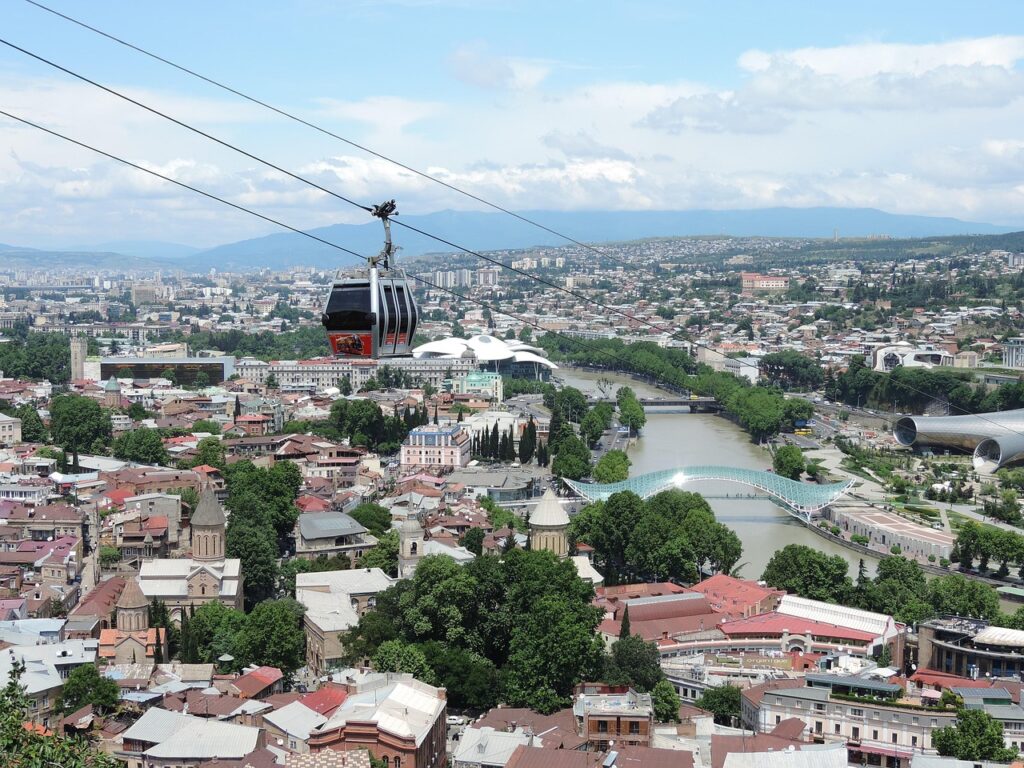
Tbilisi, the capital of the country of Georgia in the Caucasus (not the U.S. state), landed among Tripadvisor’s top trending destinations for 2026, paired in the same wave of coverage with Madeira as one of the two places suddenly dominating travel searches. The pull is a capital that still feels undiscovered: sulfur bathhouses under brick domes, a hilltop fortress reached by cable car, balconied Old Town streets stacked up a hillside, and a wine culture older than almost anywhere else on earth. Here’s what actually earns a spot on the itinerary, and what changed for visitors heading into 2026.
Quick Answer
- Best time to visit: May-June and September-October for mild weather, open mountain roads, and (in fall) the Kakheti grape harvest
- Currency: Georgian Lari (GEL) — roughly 2.7 GEL per USD and 3.0 GEL per EUR as of 2026
- Visa: around 98 nationalities enter visa-free for up to 365 days; most others get 90 days within any 180-day period
- 2026 entry rule: all foreign visitors must now carry travel health/accident insurance covering the full stay, minimum 30,000 GEL
- Getting around: Old Tbilisi and the sulfur bath district are walkable; the metro and cable car cover the rest cheaply
- Minimum trip length: 3 days for the city center; a full week if adding Kakheti wine country and Mtskheta

Old Tbilisi’s balconied houses climb the hillside beneath a brick church dome
Why Is Tbilisi Trending in 2026?
Tripadvisor named Tbilisi one of its top trending destinations heading into 2026, and the timing lines up with a city visibly changing: a wave of new hotel, restaurant, and gallery openings has reshaped the visitor experience over the past two years, while the exchange rate keeps the city considerably cheaper than most European capitals with comparable architecture and food scenes. What travelers actually find is a compact, walkable old quarter wedged into a river gorge, wrapped by hills that still hold vineyards inside the city limits — a combination almost no other capital in the region can claim.
Part of the draw is architectural layering few other capitals offer in one walk: Persian-influenced balconied wooden houses, Art Nouveau facades from the early 1900s oil-boom era, Soviet-era modernist blocks, and glass-and-steel landmarks like the Bridge of Peace sit within a few minutes of each other, alongside churches, a synagogue, and a mosque within blocks of the sulfur baths — a visible marker of the city’s long history as a crossroads between Europe and Asia.
When Is the Best Time to Visit Tbilisi?
Late spring (May-June) and early autumn (September-October) are the sweet spot: warm days, cool evenings, and mountain roads to Kakheti and the Caucasus fully open. September into October has the added draw of rtveli, the Kakheti grape harvest, when wineries across the region open their presses to visitors.
Summer (July-August) runs hot in the city center, though it’s still the easiest season for long day trips into the mountains. Winter is mild by regional standards and the cheapest time to visit, but many rural guesthouses and some wine-region tours scale back or close.
| Season | Best For | Tradeoff |
|---|---|---|
| May-Jun | Mild weather, fewer crowds, open roads | Occasional spring rain |
| Jul-Aug | Long days, mountain trips | City center runs hot |
| Sep-Oct | Grape harvest (rtveli), warm days | Vineyard tours book up early |
| Nov-Feb | Lowest prices, quiet Old Town | Cooler, some rural closures |
What Are the Best Things to Do in Tbilisi?
- Narikala Fortress & the cable car: a hilltop fourth-century fortress overlooking the whole city, reached by a modern cable car from Rike Park that typically runs from around 10am to 10pm daily — the easiest sunset view in town.
- Abanotubani sulfur baths: the domed bathhouse district that gave Tbilisi its name (the word means roughly “warm place”), fed by natural hot springs. A private room with a soak and scrub typically runs €8-12 per hour.
- Old Tbilisi’s streets: the balconied wooden houses, courtyards, and narrow lanes below Narikala are worth a slow half-day of wandering rather than a checklist stop.
- Khinkali and qvevri wine: Georgia’s soup dumplings paired with wine fermented in buried clay vessels called qvevri — a winemaking method with roughly 8,000 years of continuous history in the country and UNESCO Intangible Cultural Heritage recognition.
- Rustaveli Avenue: the city’s grand boulevard, lined with the Tbilisi Opera House, Rustaveli Theater, and several of the capital’s major museums.
- Mtskheta and Uplistsikhe day trips: Mtskheta, Georgia’s former capital a short drive from Tbilisi, holds the UNESCO-listed Jvari Monastery and Svetitskhoveli Cathedral; Uplistsikhe, a rock-hewn cave town dating back roughly 3,000 years, sits a bit farther east and pairs well with a Kakheti route.
Tbilisi’s Food and Wine Scene
A traditional Georgian meal is built around the supra, a long, toast-driven feast presided over by a toastmaster (tamada), with dishes arriving family-style rather than in courses. Beyond khinkali, look for khachapuri — cheese-filled bread, with the boat-shaped Adjaruli version (topped with a raw egg and butter) as the signature Tbilisi version — along with grilled mtsvadi skewers and walnut-heavy pkhali spreads. Wine lists lean on indigenous grapes like Saperavi (a deep red) and Rkatsiteli (an amber or white), most authentically served the qvevri way rather than in stainless steel. Old Tbilisi and the streets around Fabrika are the easiest places to find both traditional cellar restaurants and a newer wave of natural-wine bars.
Booking Tbilisi Tours & the Sulfur Baths
A guided Old Tbilisi walking tour or a booked sulfur bath slot both save time versus arranging either on the ground, especially in peak season.
Kakheti: Georgia’s Wine Country
Kakheti, roughly two hours east of Tbilisi, produces most of the country’s wine grapes and is where Georgia’s reputation as one of the world’s oldest wine-producing regions actually plays out on the ground — rolling vineyard hills framed by the Caucasus, small stone-walled towns, and family cellars still fermenting in qvevri. September and October coincide with harvest season, when many wineries invite visitors to help press grapes the traditional way.
Most visitors see Kakheti as a long day trip from Tbilisi, though travelers with a full week often base themselves in the region for a night or two around a harvest tasting.

Vineyard rows in Kakheti, Georgia’s wine country, at golden hour
Planning a Kakheti Wine Day Trip?
A guided day tour covers transport, tasting stops, and local context that’s harder to piece together solo, particularly during the harvest rush.
Do You Need a Visa for Georgia in 2026?
Georgia remains one of the more open countries to enter: roughly 98 nationalities, including the EU/EEA, UK, US, Canada, Australia, and Japan, get visa-free entry for up to 365 days per visit. Travelers from countries outside that list who are still visa-exempt typically get 90 days within any 180-day period; check current requirements for your passport before booking.
New for 2026: as of the start of the year, every foreign visitor — regardless of nationality or visa status — must hold valid health and accident travel insurance covering the full length of their stay, with minimum coverage of 30,000 GEL. This is a real change from prior years’ fully open entry and worth sorting out before departure rather than at the border.
What Currency Does Georgia Use?
Georgia’s currency is the Lari (GEL), split into 100 tetri, with banknotes from 5 to 200 GEL. As of 2026, exchange rates run roughly 2.7 GEL per US dollar, 3.0 GEL per euro, and 3.3 GEL per British pound. Cards are widely accepted in Tbilisi hotels, restaurants, and car rental counters, but carrying some cash still matters for markets, smaller guesthouses, and rural Kakheti. Bank exchange counters in the city center consistently beat airport rates, so changing a small amount on arrival and doing the rest downtown is the better move.
Renting a Car for Kakheti or Mtskheta?
A rental car opens up Kakheti’s back roads and smaller wineries that guided bus tours skip, and makes a Mtskheta detour a same-morning add-on rather than a separate booking.
How Do You Get Around Tbilisi?
Old Tbilisi, the sulfur bath district, and Rustaveli Avenue are all walkable from one another, connected by riverside paths along the Mtkvari. For anything farther out, the Tbilisi metro is cheap and covers the main north-south spine of the city, and the Narikala cable car doubles as a scenic shortcut up the hill rather than just an attraction in itself. Ride-hailing apps work reliably in the city for anything the metro doesn’t reach.
Is Tbilisi Safe to Visit?
Tbilisi is generally considered a safe capital for travelers, with violent crime against tourists rare and the Old Town, sulfur bath district, and Rustaveli Avenue all busy and well-lit into the evening. Standard city precautions apply — watch belongings in crowded markets and use licensed taxis or ride-hailing apps rather than unmarked cars at the airport. As with any international trip, register your itinerary with your government’s travel advisory service and keep the 2026 mandatory travel insurance documentation accessible in case it’s requested on arrival.
Planning More of Eastern Europe?
Frequently Asked Questions
What are the best things to do in Tbilisi?
Riding the cable car to Narikala Fortress, soaking in the Abanotubani sulfur baths, wandering Old Tbilisi’s balconied streets, and eating khinkali with qvevri wine consistently top visitors’ lists, alongside a Kakheti wine day trip for travelers with more time.
Do I need a visa to visit Georgia in 2026?
Around 98 nationalities, including the EU/EEA, UK, US, Canada, Australia, and Japan, can enter visa-free for up to 365 days. Other visa-exempt nationalities generally get 90 days within a 180-day period. As of 2026, all foreign visitors must also carry travel health/accident insurance covering their full stay, minimum 30,000 GEL.
What is the best time to visit Tbilisi?
May-June and September-October offer the mildest weather and open mountain roads. September-October also coincides with rtveli, the Kakheti grape harvest.
What currency does Georgia use?
The Georgian Lari (GEL). As of 2026, roughly 2.7 GEL equals 1 USD and 3.0 GEL equals 1 EUR. Cards are widely accepted in Tbilisi, but cash still matters for markets and rural areas.
How many days do you need in Tbilisi?
Three days covers the city center comfortably. A full week allows adding a Kakheti wine-region trip and a Mtskheta day trip without rushing either.
Is Tbilisi walkable?
The Old Town, sulfur bath district, and Rustaveli Avenue are all walkable from each other. The metro and the Narikala cable car cover the rest of the city cheaply for anywhere farther out.
Final Thoughts
Tbilisi’s 2026 trending status holds up on the ground: a walkable, balconied Old Town, a genuinely ancient bathhouse and wine culture, and a wine region a short drive away that few first-time visitors expect from a Caucasus capital. Sort out the new 2026 insurance requirement before departure, aim for May-June or September-October, and budget at least three days in the city plus extra for Kakheti if the schedule allows.
Keep Exploring
More destination guides, packing lists, and itinerary breakdowns to help plan your next trip.